Sydney Accessible Transport From Circular Quay Ferries to the City Trains
How Sydney's ferries, trains, and light rail work for wheelchair users, and which hillside stations to skip in favour of the bus.
Sydney Accessible Transport from Circular Quay Ferries to the City Trains
Sydney's ferries are the best accessible transport win in this harbour city. Its hillside train stops are its worst failure. The ferry fleet boards every passenger with a ramp and handrail. The train network leaves 222 of 369 stops without any wheelchair lift at all. Here is exactly how each mode works, which wharves and stops to skip, and where to turn to the bus network instead.
You need an Opal card to travel on any mode. Buy one at any newsagent, convenience store, or the Circular Quay ferry ticket office. The Gold Opal for seniors and pensioners caps daily fare at $2.50 (2025 rate from Transport for NSW). For vision impaired passengers, a free travel pass is loaded onto an Opal card for unlimited travel on all trains, buses, ferries and light rail. For everyone else, the standard daily cap is around $16.80 on trains and $8.10 on ferries depending on the modes used.

Ferries Level Boarding and the Tide Problem
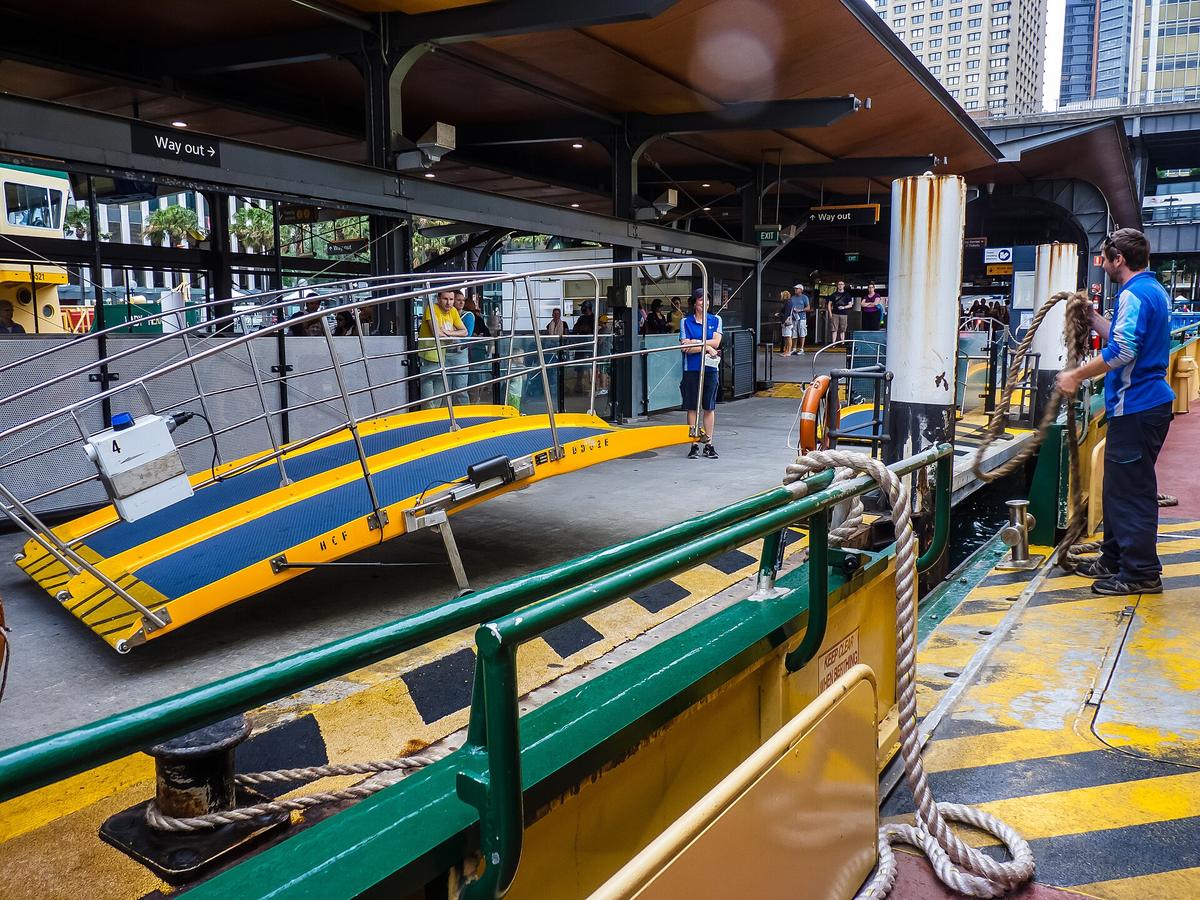
Every Sydney Ferries vessel has level boarding at wharves with accessible pontoons. The crew deploys a boarding ramp with handrails. Door width on Freshwater, Emerald and RiverCat class ferries is a minimum 800 mm clear opening. That is wide enough for a standard manual chair or a power chair plus arm rests.
Step Free Wharves You Can Use
Eighteen wharves are fully step free: Circular Quay (all berths), Manly, Taronga Zoo, Darling Harbour (Barangaroo), Pyrmont Bay, Balmain East, McMahons Point, Milsons Point, Neutral Bay, Kirribilli, Cremorne Point, Mosman Bay, Double Bay, Rose Bay, Watsons Bay, Cockatoo Island, Cabarita, Chiswick, Abbotsford and Parramatta. That list from Transport for NSW's 2025 access map covers the main tourist routes plus the inner western line. Plan your trip around these.
The Five Wharves With Only Steps
Five wharves have no ramp, only stairs: Balmain (Thames Street), Birchgrove, Greenwich Point, Woolwich and Huntleys Point. Do not book a trip that ends at these. There is no level alternative within walking distance. If your accommodation is near one, your fallback is a wheelchair accessible taxi or a bus to the nearest step free wharf.
The Low Tide Ramp Warning
Even step free wharves can become difficult. Balmain East ramp gradient exceeds 1:14 at low tide when the water level drops below 0.4 metres. A 1:14 slope is steep for a manual chair user to self propel upward and could tip a power chair backward. Check the tide chart for Sydney Harbour before you go. Call 131 500 and ask the wharf staff: "What is the ramp gradient at Balmain East at today's low tide and is staff assistance available for boarding?" Arrive at slack tide or high tide to avoid the steepest angle.
Trains the 147 Station Solution and the Inner City Trouble
Only 147 of Sydney's 369 train stops have independent wheelchair access via a lift or a level path from street to platform. That means the rest are completely inaccessible without help. The horizontal gap on curved platforms at older stops can reach 320 mm with a vertical step up to 280 mm. A 320 mm gap is too wide for most chair casters. You cannot board safely without a ramp, and most stops do not carry one.
The Seven CBD Stops With Lifts
Inside the CBD, seven locations have lift access: Central, Town Hall, Wynyard, Circular Quay, Martin Place, Museum and St James. All these are on the City Circle line. You can move between them underground. Use these for all your inner city journeys. Avoid Redfern platforms 1 through 10, which have only step access; platform 11 and 12 have a lift, but platform 11 is on the Airport and South line only.
The Four Inner City Stops to Never Use
Macdonaldtown, Erskineville, St Peters and Redfern platforms 1 through 10 have no lift. These serve the inner west suburbs Newtown, Erskineville and St Peters. If you are staying in those neighbourhoods, do not walk to the railway. Use a wheelchair accessible taxi or the bus network instead. Every Sydney metropolitan bus has a low floor entry and a manual or electric ramp.
Train Lift Dimensions and Phone Check
Lifts at stops upgraded after 2015 measure 1100 mm wide by 1400 mm deep. That fits most power chairs and manual chairs with a helper. Older lifts vary between 900 mm and 1100 mm width. Before you travel to a stop with an older lift, call 131 500 and ask: "Is the lift at [name] currently in service, and if not, what alternative accessible transport is arranged?" A broken lift at a stop with only one shaft means you are stuck on the platform.
| Station | Lift Width | Lift Depth | Platforms Served |
|---|---|---|---|
| Central | 1100mm | 1400mm | All platforms including intercity |
| Town Hall | 1100mm | 1400mm | All City Circle platforms |
| Wynyard | 1000mm | 1400mm | All City Circle platforms |
| Circular Quay | 1100mm | 1400mm | All City Circle platforms |
| Martin Place | 1100mm | 1400mm | All City Circle platforms |
| Museum | 950mm | 1300mm | Single island platform |
| St James | 950mm | 1300mm | Single island platform |


Light Rail Level Boarding and the Bus Fallback
Every light rail stop on the L1 Dulwich Hill line, L2 Randwick line and L3 Kingsford line has level boarding. The gap between tram and platform is 40 mm horizontal and 20 mm vertical at most. That is a small bump, not a step. Each Citadis X05 tram has two wheelchair spaces measuring 1300 mm by 800 mm. The light rail runs through the CBD, Darling Harbour, Chinatown and the eastern suburbs. It is the best option for getting from Central to the entertainment precincts.
If a train stop is inaccessible and the light rail does not reach your destination, use the bus. The entire Sydney metropolitan bus fleet is wheelchair accessible with a low floor entry. The ramp deploys at a maximum gradient of 1:8 when the kerb is the standard 150 mm high. Wheelchair bays are rearward facing with a backrest and lap belt. Buses run every 10 to 15 minutes on most inner city routes.
The bus is also your fallback for the hillside inner suburbs such as Paddington, Glebe, Balmain and Surry Hills where streets have punishing gradients. King Street between George and York hits 12.5%. Erskine Street between Clarence and Kent reaches 14.2%. Argyle Street in The Rocks climbs 16%. Do not attempt to push uphill on those. Board a bus at the bottom of the hill instead.
Accessible Taxis, Toilets and the Thing That Usually Fails
When public transport breaks down or the hill is too steep, turn to the wheelchair accessible taxi fleet. In 2025 there were 100 such vehicles in the Sydney metropolitan area. Book by calling 131 008. Wait times at peak hour can exceed 40 minutes. The NSW Taxi Subsidy Scheme covers half the fare up to $60 per trip for eligible residents with severe permanent disability. You need medical assessment and must apply using form TSS 01 from the Transport for NSW website. The annual cap is $120 per calendar year. Visitors cannot use the scheme.
Accessible toilets are available at key transport hubs. Circular Quay Wharf 3 has one open 0700 to 1900. You need an MLAK key which you can buy at most hardware stores. Central Grand Concourse near Platform 1 has one open 24 hours with no key required. Town Hall concourse near the George Street exit is open 0600 to 2200. Wynyard concourse near the York Street exit is open 0600 to 2200. Plan your bladder stops around these.
The single thing that most often goes wrong here is assuming that because a location is in central Sydney it has a lift. Redfern, Macdonaldtown, Erskineville and St Peters do not. Redfern looks central on the map but platforms 1 through 10 are stair only. The walk from Redfern to the bus stop on George Street is 300 metres uphill on a gradient over 10%. Check the lift status before you leave your hotel. If you do not, you will be stuck on a platform with no way down to street level.
Common Questions
What do I do if the lift is out of service at my train station?
Call 131 500 before you travel. If a lift is broken, Sydney Trains must arrange an alternative accessible transport, usually a wheelchair accessible taxi at no cost to you. Do not attempt to board via escalators. Wait for staff assistance or take a bus to the next accessible location.
Can I use a standard wheelchair on all Sydney Ferries?
Yes, if the wharf has an accessible pontoon and the ferry has a door width of at least 800 mm. Freshwater, Emerald and RiverCat class vessels all meet this. Check the wharf list above. Avoid the five step only wharves. Call ahead about tidal ramp gradient at Balmain East.
How do I book a wheelchair accessible taxi in Sydney?
Call 131 008 for combined NSW Taxi Council booking. There were 100 wheelchair accessible taxis in the 2025 Sydney fleet. Book at least 30 minutes ahead. If you are a NSW resident with a severe permanent disability, apply for the Taxi Subsidy Scheme on form TSS 01 for half the fare up to $60 per trip.
What is the steepest street in central Sydney I should avoid?
Argyle Street in The Rocks at 16% gradient. Also Erskine Street between Clarence and Kent at 14.2% and King Street between George and York at 12.5%. Do not self propel on these. Use the light rail or a bus to cross the area instead.
Read next
-
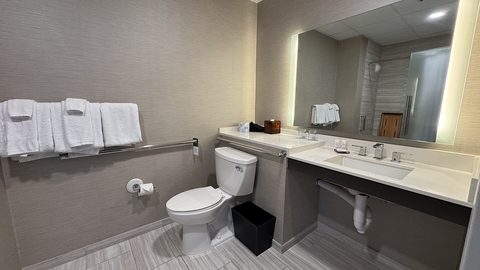
 Accessible Hotels in Sydney CBD and the Harbour Without the Surprise
Which Sydney CBD and harbourfront hotels offer genuine wheelchair access where the accessible room is not a downgrade in space or view.
Accessible Hotels in Sydney CBD and the Harbour Without the Surprise
Which Sydney CBD and harbourfront hotels offer genuine wheelchair access where the accessible room is not a downgrade in space or view.
-
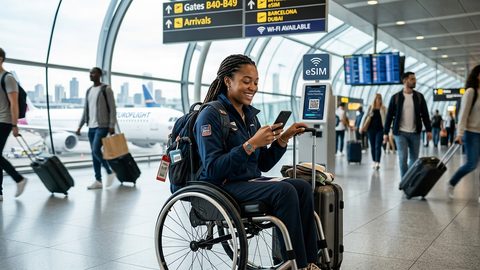 Mobile Data Planning for Wheelchair Users Traveling Abroad With eSIM
Plan mobile data for wheelchair travel abroad, with eSIM setup checks, lift outage updates, transport contacts, repair planning, and offline backups.
Mobile Data Planning for Wheelchair Users Traveling Abroad With eSIM
Plan mobile data for wheelchair travel abroad, with eSIM setup checks, lift outage updates, transport contacts, repair planning, and offline backups.