Disabled Travel in Singapore, the Most Step-Free City in Asia
Singapore's MRT is fully step-free, hawker centres have accessible seating, and the building code demands barrier-free access, making it probably Asia's most wheelchair-friendly city.
- Flag
-

- ISO code
- SG
- Population
- 5,638,676
- Currency
- SGD
- Dial code
- +65
Singapore Wheelchair Access is Not an Accident
No other city in Asia has done what Singapore has. Every one of its 142 MRT stops is step free. Every public bus has a wheelchair bay. More than 200 kilometres of covered walkways thread the island. This is not gradual retrofitting. It is the product of a deliberate building code, the Code on Accessibility in the Built Environment 2019, which requires barrier free access in all new buildings and major renovations. The Land Transport Authority mandated that every stop built after 1990 include lifts and tactile guidance. A wheelchair user can travel from Changi Airport to Tuas Link without encountering a single step. That is the single most useful fact for planning a visit. Plan your trip around the MRT and you solve 80 percent of your access problems before you arrive.
The MRT: Fully Step Free Since December 2020
The Thomson East Coast Line Stage 2 opened in December 2020 and completed the last gap in the network. Every stop now has lifts, ramps, tactile guidance, and wide fare gates. Platform screen doors are fitted at every above ground and underground location, a safety feature that also means you never face a gap between train and platform. Hearing loops are installed at every passenger service counter. The system uses the induction loop standard, so check that your hearing aid has a T switch before you travel.
Use the MyTransport.SG app or the SMRT Lift Status page to check real time lift faults before you set out. Singapore is humid and the MRT runs below ground for long stretches; the air conditioning in the stops and trains sits between 22 and 26 degrees Celsius, a relief after thirty seconds outside. Board at the front or rear carriage where the gap is smallest.
Buses and the Ramp Routine
Buses are also fully accessible. Every public bus in the fleet has a wheelchair bay. The driver deploys a manual flip out ramp at the rear door on request. Flag the bus down and tell the driver you need the ramp. One catch: buses do not have hearing loops. If you use a hearing aid, call the bus operator and ask whether a hearing loop is fitted on the model serving your route number. Do not assume it is.
The Covered Walkway Network
The Walk2Ride programme guarantees a covered walkway within 400 metres of every MRT stop and within 200 metres of every bus interchange and LRT stop. The network is 200 kilometres long and still growing. It connects you from exit to mall entrance, hawker centre, and public building without exposure to rain or direct sun. In practice, this means you can travel the length of Orchard Road, from the Dhoby Ghaut end to the Orchard Boulevard end, entirely under cover. The heat index outdoors ranges from 32 to 42 degrees Celsius year round. Those covered walkways are not a luxury. They are the difference between a manageable trip and a dehydration risk.
Taxis And Private Hire Vehicles
The accessible taxi fleet numbers more than 2,400 vehicles, including London style cabs and side loading ramp vans. Book through the ComfortDelGro CDG Zig app or Grab, which lets you select the Assist or Wheelchair Accessible vehicle type. Gojek has a much smaller accessible fleet. When you book, call the operator and ask two questions: whether the vehicle is a London cab or a side loading ramp van, and what the maximum wheelchair width it can take. London cabs accept most standard chairs but not power chairs wider than the cabin door frame. Side loading ramp vans handle larger chairs.
GrabAssist and GrabWheelchair options include drivers trained in ramp deployment and securement. Call them to confirm the training. Do not assume that selecting the accessible option automatically guarantees a trained driver. Singapore has a strong regulatory framework, but the private hire sector still varies by operator.

Hawker Centres and Accessible Tables
Hawker centres are the heart of Singaporean eating, and they are surprisingly accessible. The Building and Construction Authority code requires that at least 2 percent of seating be accessible tables, positioned on a level surface with clear knee space underneath. Most newer hawker centres, like the ones in Tiong Bahru, Old Airport Road, and Golden Mile Food Centre, comply. The tables are near the entrance or along a clear circulation path. The challenge is the floor. Wet tiles are common. Wipe your wheels dry before you enter and head for the tables nearest the centre aisle, where foot traffic is lower.
Accessible toilets in hawker centres are less reliable. The code requires them, but maintenance is inconsistent. Some centres lock the accessible toilet and keep the key behind a counter. You may need to ask a cleaner or a stallholder. Budget for this delay. A better strategy is to use the accessible toilet in the nearest MRT stop before you eat. Every one has one.
Malls: Long Distances But Good Access
Major malls are built to code, but internal walking distances are large. The distance from the MRT fare gate to the key anchor tenant in ION Orchard, VivoCity, or Suntec City can stretch to several hundred metres. That is a long push on a hot day. Use the mall directory kiosks to find the shortest step free route and aim for the lift bank nearest the MRT exit. Do not trust a single sign; check two. The air conditioning inside the malls is 22 to 26 degrees Celsius, the same range as the MRT, so plan to use the underground linkways between stops and malls to keep cool.
Attractions That Work And One That Does Not
Gardens by the Bay, Marina Bay Sands, National Gallery Singapore, the ArtScience Museum, Singapore Zoo, River Wonders, Bird Paradise, and Universal Studios Singapore all have step free routes, accessible toilets, and lifts. Their respective venue websites confirm compliance with the 2019 building code. National Gallery Singapore has induction loops in selected galleries and in the theatre. The Esplanade concert hall and theatre use an infrared assistive listening system. Before you go, phone the venue and ask which specific spaces have a hearing loop or assistive system, and what type of receiver you need. The answers differ by space.
Skip the Night Safari. It is not built for wheelchairs. The lighting is low. The paths are unpaved. The tram is inaccessible. The zoo is the better choice. Arrive at Singapore Zoo by 08:30, enter through the main gate, and do the tram route first before the heat builds. For a city that makes step-free travel effortless, Tokyo’s accessible rail network offers a striking contrast to Singapore’s compact walkability.
Where Singapore Still Falls Short: Shophouses and Food Courts
Singapore's accessibility is excellent for a modern city, but it is not perfect. The shophouse districts of Chinatown, Kampong Glam, Little India, Joo Chiat, and Katong preserve the original five foot way width of 1.2 to 2.4 metres. That is wide enough for a wheelchair, but the conservation guidelines from the Urban Redevelopment Authority do not require standard kerb cuts between the shophouse and the road. You will find steps at individual shop thresholds, sometimes high enough to block a chair, with no ramp. Stay on the main roads and use the MRT stops that border these districts. In Chinatown, the Chinatown MRT exit on Pagoda Street gives you a level path to the pedestrian mall. In Little India, the Farrer Park MRT exit on Serangoon Road is the flattest route.
The second shortfall is accessible toilets in food courts. Many smaller food courts in shopping centres were built before the 2019 code took effect. They either lack an accessible toilet entirely or share one with the mall, which may be locked or cluttered with storage. Again, the MRT toilet is your fallback. Every stop has a clean, maintained accessible toilet. Build your itinerary around station proximity and you avoid the problem.
The Heat: Your Real Opponent
The heat and humidity are the unspoken access challenge. The average daytime feels like temperature is 32 to 42 degrees Celsius. Relative humidity is 70 to 95 percent. This affects everyone, but it affects wheelchair users more. You are seated. You are close to hot pavement. Your push muscles fatigue faster in high heat. Your chair surface absorbs heat. Carry a cooling towel, an insulated water bottle, and a portable fan. Plan your outdoors time for before 10:00 or after 16:00. Use the covered walkways. Do not try to cover a shophouse district and an outdoor attraction on the same morning. That is a plan that sounds good on paper and fails before lunch.


Frequently Asked Questions
Can I use the MRT with a power wheelchair?
Yes. Every stop has lifts that accept power chairs. The wide fare gates accommodate most chair widths. The gap between platform and train is less than 75 millimetres on all lines.
Are there accessible taxis at Changi Airport?
Yes. The taxi queue at Changi has a dedicated accessible taxi bay. The fleet includes London cabs and ramp vans. Use the CDG Zig app to book one in advance if you want to guarantee availability.
Do I need to tip for wheelchair assistance at hotels?
No. Singapore has a strict no tipping culture. Hotels and taxis do not expect gratuities for help with luggage or ramp deployment. A polite thank you is standard.
Is the Sentosa boardwalk wheelchair accessible?
Yes. The Sentosa Boardwalk from VivoCity to Sentosa is fully step free with ramps at every junction. It is covered. You can also take the Sentosa Express monorail, which has level boarding.
Read next
-
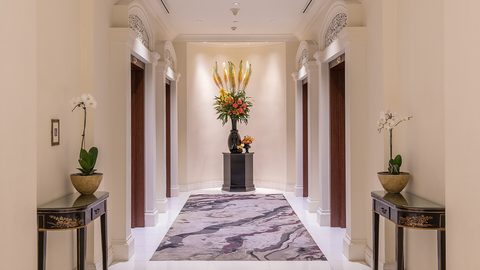 Accessible Hotels in Singapore Where the Roll-In Shower Is Standard
Which Singapore hotels offer genuine roll-in showers and adequate turning space, not just a grab bar added to a standard bathroom.
Accessible Hotels in Singapore Where the Roll-In Shower Is Standard
Which Singapore hotels offer genuine roll-in showers and adequate turning space, not just a grab bar added to a standard bathroom.
-
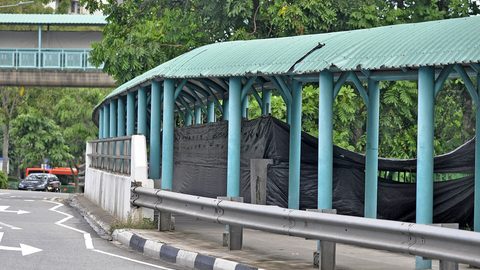 Getting Around Singapore in a Wheelchair Without a Single Step
How Singapore's MRT, buses, and ride-hailing actually work for wheelchair users, from Changi Airport arrivals to the last shophouse curb cut.
Getting Around Singapore in a Wheelchair Without a Single Step
How Singapore's MRT, buses, and ride-hailing actually work for wheelchair users, from Changi Airport arrivals to the last shophouse curb cut.
-
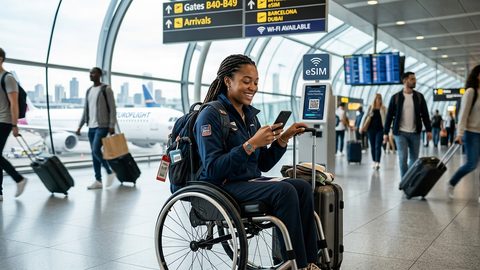 Mobile Data Planning for Wheelchair Users Traveling Abroad With eSIM
Plan mobile data for wheelchair travel abroad, with eSIM setup checks, lift outage updates, transport contacts, repair planning, and offline backups.
Mobile Data Planning for Wheelchair Users Traveling Abroad With eSIM
Plan mobile data for wheelchair travel abroad, with eSIM setup checks, lift outage updates, transport contacts, repair planning, and offline backups.