How to Use Every Accessible Transport Option in Singapore
How Singapore's MRT, buses, and ride-hailing actually work for wheelchair users, from Changi Airport arrivals to the last shophouse curb cut.
Singapore Has 142 MRT Stations and Every Single One Has a Lift
The last retrofit finished in December 2020. Every stop on the 2024 Land Transport Authority network now has a step-free route from street to platform. The lift network is complete. You do not need to check stop by stop before you travel.
The gap you must watch is the platform gap. By LTA design standard it ranges from 25 mm to 75 mm depending on curvature. That is manageable with a standard wheelchair castor. The bigger risk is the platform screen doors. They stand 1.5 metres high. If your chair height exceeds that, your head or backrest can clip the door frame. Test your clearance against a door before you commit to a train.
Guidance, Seating And Announcements
The tactile guidance path runs continuous 300 mm wide from every entrance to the boarding point. Priority seating gives you a minimum of two designated wheelchair spaces per car. Audio announcements call every stop and interchange in English on all lines. Real-time next-train displays sit at every platform with LED text and colour-coded route maps. Hearing induction loops are installed at all passenger service counters.
The Real Failure Point Is The Interchange Walk
The failure case here is not the lift. It is the interchange walk. Dhoby Ghaut requires a 150 metre transfer between the North South Line and North East Line platforms. City Hall to Esplanade is 400 metres through an underground link. Budget 10 to 15 minutes for those transfers. If you have limited stamina, use the accessible taxi for multi-line journeys instead.

Buses Are 100% Accessible but the Ramp is Manual and Slow
All 5,800 public buses as of 2024 have a wheelchair bay. The bay measures 1,300 mm by 750 mm. That fits a standard manual chair and most power chairs under the LTA weight specification. There is one bay per bus. If it is occupied, you wait for the next bus.
The ramp is a manual fold-out at the rear door. Gradient runs from 1:6 to 1:8 depending on kerb height. Maximum load is 300 kg. The driver deploys it on request. Expect a 30 to 60 second delay before boarding. Bus priority boarding areas are marked on the floor at interchanges with a 900 mm wide space. Audio next-stop announcements and LED visual displays operate on all buses.
Peak Hours Will Defeat You
The failure point is time. In peak periods 07:00 to 09:00 and 17:00 to 20:00, multiple wheelchair users may converge on the same route. If the bay is taken, the driver cannot board you. The bus simply leaves. You then wait for the next bus. That wait could be 10 to 20 minutes depending on frequency. Skip buses during those two windows if you have a fixed appointment. Use the MRT or an accessible taxi instead.
Changi Airport Has a 48 Hour Booking Rule You Cannot Skip
Special assistance at Changi requires you to book through your airline at least 48 hours before departure. That is the Changi Airport Group rule as of 2024. Walk-up requests at the information counter will get you a free wheelchair loan, but only if stock is available. Do not rely on that for a flight connection.
Terminal transfers use the Skytrain, which is fully step-free with a platform gap of 25 to 50 mm. Accessible toilets are in all terminals with 900 mm door width and an emergency alarm pull cord to floor level. Designated waiting areas for assistance are near check-in rows 1, 5 and 9 in Terminal 1, rows 1, 6 and 10 in Terminal 2, rows 1, 5 and 9 in Terminal 3, and row 1 in Terminal 4.
Book Early, Then Confirm
Book the assistance when you book your ticket. Do not leave it to the day before. If your airline does not confirm the booking within 24 hours, call them. The 48-hour rule is a minimum. If you arrive without a booking, go to the designated waiting area for your terminal and expect a 20 to 40 minute wait for an available crew member. For a similarly step‑free experience on extraordinary rail and everything else that is harder, Tokyo demands the same early planning.
Grab Assist Works but You Need 30 to 60 Minutes Lead Time
The accessible taxi fleet sits at about 1,000 vehicles as of 2024. That covers London-style cabs and converted vans. They are bookable through the ComfortDelGro app, Grab Assist, and Gojek. Grab Assist is the most reliable for on-demand booking. Lead time is 30 to 60 minutes. During peak hours 07:00 to 09:00 and 17:00 to 20:00, expect longer waits. At those times, book 90 minutes ahead.
Measure Before You Arrive
The rear-entry ramp gradient runs 1:4 to 1:6. Internal wheelchair space is 1,200 mm by 750 mm minimum. That fits most manual chairs. Power chairs with a length over 1,200 mm or a width over 750 mm may not fit. Measure your chair before you arrive. If your chair is oversized, book a converted van through the ComfortDelGro app, which has a larger interior.
The 1 am Problem
The failure case is 1 am. Taxi availability drops sharply after midnight. The fleet size remains the same, but driver shift patterns cluster around daytime hours. If you need a ride out of a club district at 1 am, budget a 60 to 90 minute wait. The alternative is the MRT, which stops running around midnight. Plan your return transport before you go out.


The Last Metre Ruins it Every Time
Singapore has 200 km of covered walkways connecting every MRT stop within 400 metres and every bus interchange within 200 metres. The walkways meet a minimum width of 1.8 metres. Public hospitals are all connected. The covered walkway network is a genuine achievement.
The Shophouse Trap
The problem sits in the older shophouse districts: Chinatown, Kampong Glam, Little India, and the Joo Chiat area. A covered walkway ends at the main road. The last 10 to 30 metres to a shophouse entrance has a single step. Sometimes two steps. Sometimes a kerb with no cut-out. The shophouse itself may have a 50 mm threshold. One step is enough to stop a manual chair user who has no ramp.
Three Questions To Ask Before You Go
The solution is to call ahead with three precise questions. Ask the property: what is the clear door width of the bathroom in millimetres, measured with the door open at 90 degrees? Is there any step, even a single one, between the drop-off point and the room, including fire doors with raised thresholds? Does the shower have a lip or threshold, and if so what is its height in millimetres? The answer to the second question will tell you whether your visit is possible without a portable ramp. If the answer is yes to a step, carry a portable ramp rated for your chair weight. The LTA Accessibility Code 2019 edition is the current standard, but it does not cover private shophouse thresholds. That gap is yours to manage.
Common Questions
Can I get from Changi Airport to the city centre step free?
Yes. The MRT line from Changi Airport to Tanah Merah is fully step free. The Skytrain between terminals is step free with a 25 to 50 mm platform gap. Book airport assistance 48 hours ahead through your airline.
Do all MRT stations have a lift?
Yes. All 142 stops as of the 2024 LTA network map have a lift. The last retrofit finished in December 2020. Platform gaps range from 25 to 75 mm depending on curvature.
How long do I need to wait for an accessible taxi?
30 to 60 minutes. During peak hours 07:00 to 09:00 and 17:00 to 20:00, expect longer waits. At 1 am, budget 60 to 90 minutes. Book through Grab Assist or ComfortDelGro app.
What is the ramp gradient on a public bus?
The manual rear-door ramp runs at a gradient of 1:6 to 1:8 depending on kerb height. Maximum load is 300 kg. The driver deploys it on request. Expect a 30 to 60 second delay before boarding.
How do I check if a hotel room is actually accessible?
Call the hotel directly. Ask: what is the clear door width of the bathroom in millimetres with the door open at 90 degrees? Is there any step between the drop-off point and the room? Does the shower have a lip or threshold in millimetres? Do you have rooms with a visual fire alarm strobe light and a vibrating pillow pad? Accor, Marriott International, and Pan Pacific Hotels Group publish accessible room specifications, but verify per property.
Read next
-
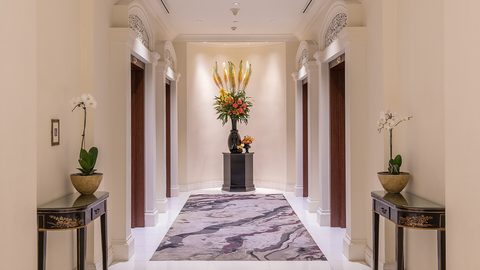
 Accessible Hotels in Singapore Where the Roll-In Shower Is Standard
Which Singapore hotels offer genuine roll-in showers and adequate turning space, not just a grab bar added to a standard bathroom.
Accessible Hotels in Singapore Where the Roll-In Shower Is Standard
Which Singapore hotels offer genuine roll-in showers and adequate turning space, not just a grab bar added to a standard bathroom.
-
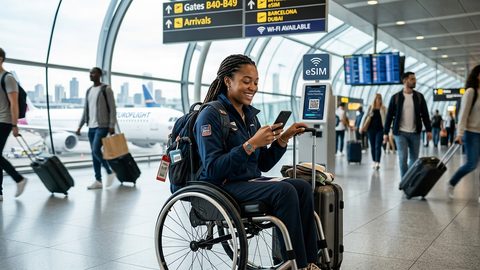 Mobile Data Planning for Wheelchair Users Traveling Abroad With eSIM
Plan mobile data for wheelchair travel abroad, with eSIM setup checks, lift outage updates, transport contacts, repair planning, and offline backups.
Mobile Data Planning for Wheelchair Users Traveling Abroad With eSIM
Plan mobile data for wheelchair travel abroad, with eSIM setup checks, lift outage updates, transport contacts, repair planning, and offline backups.