Disabled Travel in Amsterdam, Flat but Never Simple
Amsterdam is flat but never simple for wheelchair users. Steep canal bridges, narrow Jordaan pavements, and historic houses with entrance steps demand planning.
- Flag
-

- ISO code
- NL
- Population
- 741,636
- Currency
- EUR
- Timezone
- Europe/Amsterdam
The Flat Deception: Why Amsterdam is Harder Than it Looks
Amsterdam has 1,200 bridges in its Centrum district alone, and almost every one of them has a gradient between 8% and 12%. Some exceed 14%. That slope, on a street surface of fired clay bricks with uneven 3 5 mm joints, is the real obstacle for a wheelchair user, not the altitude. The city is dead flat. The terrain gives you nothing to fear. The infrastructure does.
Plan for the bridges before you plan for the attractions. A 12% gradient on a canal bridge is steep enough that a manual wheelchair user will need a running start or a push from a companion. Power chair users can manage most of them, but the cobble joints will rattle teeth and the tram tracks running through those same streets create a 40 45 mm flangeway gap that can trap a 50 mm castor wheel. You will cross a bridge every few hundred metres in the canal belt. Budget an extra 30 seconds per crossing for the climb and another 15 seconds to align your wheels with the track grooves on the far side. That is not pessimism. That is the cadence of the city.


Trams: Better but Not Reliable Yet
Which Trams You Can Board
Book your GVB travel pass knowing that not every tram route is accessible. As of the 2026 timetable, every tram line except route 19 runs low floor 15G CAF Urbos 100 trams. Those 15G trams have a retractable ramp at door 2 and provide level boarding at stops raised to 210 mm above the rail. The problem is the stops that are not raised. Older stops sit at 50 100 mm, which means a drop of more than 100 mm from the tram floor to the street. The tram itself cannot fix that.
Call GVB customer service on +31 900 8011 before you travel and ask two specific questions: "Does tram route [number] use low floor trams at [your stop] today?" and "Is the platform at [stop name] raised to 210 mm?" The second question matters more than the first. A low floor tram parked at a low platform is still inaccessible. The 11G and 12G trams, fleet numbers 901 920 and 2201 2251, have three steps at every door and no wheelchair access at all. Those trams still run on line 19 and as backup stock on other lines. Do not board one. Wait for the next 15G.
The Metro: Gaps and Ramps
The metro is simpler. All 39 stations have step free access from street to platform via lift or ramp. The gap between platform and train can be up to 170 mm horizontally and 50 mm vertically on older M5 and M4 stock. The M7 series has an automatic gap filler. M5 and M4 trains require a crew deployed ramp. Allow an extra two minutes for the driver to reach your door and set up the ramp. That is standard. Do not assume the ramp will arrive before you do.
Hotels with No Bridges to Cross
The single most useful decision you will make in Amsterdam is where you sleep. Stay in the IJ waterfront district, specifically the Oosterdok, Westerdok or Piet Heinkade areas. Those neighbourhoods have zero canal bridges between the hotel and Centraal Station. You roll from your hotel door to the station underpass at De Ruijterkade via lifts that operate 24/7. Every other central district will require you to cross at least one bridge with a gradient over 8%. The Jordaan, the Negen Straatjes and the area around the Westerkerk are beautiful and narrow and impassable for a wheelchair user after a few blocks. The pavements in the Jordaan are too narrow for two wheelchairs to pass. The historic buildings have entrance steps. Skip the charm. Book the IJ side.
Centraal Station Lift Strategy
Centraal Station itself has lifts on every platform from the main hall and from the IJ side underpass. Those lifts run 24 hours a day. Check the live lift status on the NS app or call NS customer service on +31 30 751 5155 if you want confirmation the morning of your departure. Lift outages happen. Have a backup route that uses the other entrance. The station has two lift banks. Use the one that works. For a direct wheelchair-accessible rail connection, Eurostar trains link Amsterdam Centraal with London St Pancras, where a similar focus on step-free travel awaits.


Museums, Canals and Taxis: the Specific Workarounds
Rijksmuseum and Van Gogh Museum
Both are fully accessible from the pavement. The Rijksmuseum main entrance at Museumstraat 1 has level access and automatic doors with lifts to all floors. Reserve a free manual wheelchair by phoning +31 20 674 7000 or emailing accessibility@rijksmuseum.nl. The Van Gogh Museum at Museumplein 6 has a ramp at the main entrance and lifts to every exhibition floor. Wheelchairs are free and reserved by calling +31 20 570 5200. Both museums have hearing loops. Arrive at opening time. By 11:00 the Museumplein is dense with pedestrians and the cobble surface around the square is tiring to cross.
Canal Cruises With A Ramp
Three operators have accessible boarding pontoons and ramps at their main docks. Lovers Canal Cruises docks at Prins Hendrikkade 25. Blue Boat Company docks at Stadhouderskade 30. Stromma docks at Damrak Pier 5. Before you book, call the operator and ask two questions: "Is the boarding ramp fixed or portable today?" and "Does the boat on this sailing have an accessible toilet?" Blue Boat and Lovers report accessible toilets on their main fleet vessels. Stromma reports none. If you need a toilet on board, book Blue Boat or Lovers. If you do not, Stromma's Damrak dock is the most central and the easiest to reach from Centraal Station.
Taxis And The Accessible Fleet
Standard Amsterdam taxis are not wheelchair accessible. The dedicated fleet runs about 50 vehicles operated by TTO, Taxi Toegankelijk voor Allen, bookable on +31 20 777 7777. Book at least 24 hours ahead for airport transfers and at least two hours ahead for same day trips. The accessible taxi is not a hail and ride service. Plan every taxi journey the night before.
Common Questions
Can I use my European Disability Card on GVB services?
Yes. The card is accepted on all GVB metro, tram and bus services. Your companion travels free when you show the card. No additional paperwork needed.
Which tram routes still run inaccessible high-floor trams?
Line 19 is the only route that does not guarantee low-floor trams as of the 2026 timetable. The older 11G and 12G trams can appear on any line as backup. Wait for the next 15G.
How steep are Amsterdam's canal bridges in numbers?
Most city-centre bridges range from 8% to 12% gradient, or 1:12 to 1:8. Some exceed 14%. A 12% slope is steep enough that a manual chair user may need assistance on the ascent.
Are there accessible toilets on canal cruise boats?
Blue Boat Company and Lovers Canal Cruises report accessible toilets on their main fleet vessels. Stromma reports none on standard canal boats. Ask before you book.
Read next
-
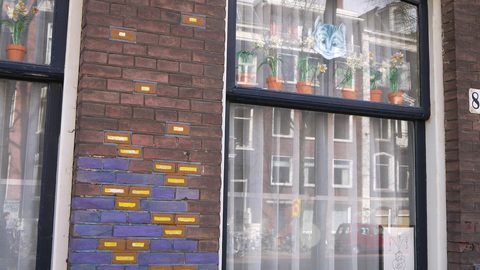 Accessible Hotels in Amsterdam Narrow Houses and the Lift Problem
Why Amsterdam's narrow canal houses create a unique lift problem for wheelchair users and where to find hotels with genuine access.
Accessible Hotels in Amsterdam Narrow Houses and the Lift Problem
Why Amsterdam's narrow canal houses create a unique lift problem for wheelchair users and where to find hotels with genuine access.
-
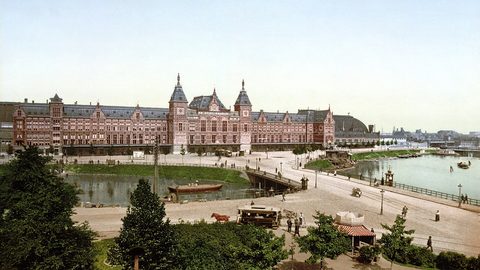 Getting Around Amsterdam for Disabled Travellers Trams Bridges and Cobbles
A practical guide to Amsterdam's accessible transport, from the tram lines with level boarding to avoiding the steepest canal bridges.
Getting Around Amsterdam for Disabled Travellers Trams Bridges and Cobbles
A practical guide to Amsterdam's accessible transport, from the tram lines with level boarding to avoiding the steepest canal bridges.
-
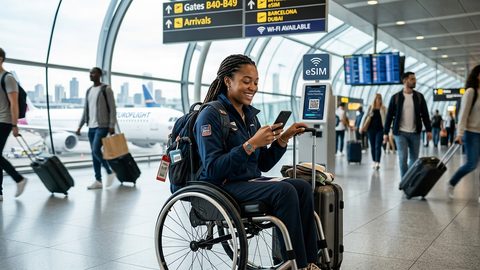 Mobile Data Planning for Wheelchair Users Traveling Abroad With eSIM
Plan mobile data for wheelchair travel abroad, with eSIM setup checks, lift outage updates, transport contacts, repair planning, and offline backups.
Mobile Data Planning for Wheelchair Users Traveling Abroad With eSIM
Plan mobile data for wheelchair travel abroad, with eSIM setup checks, lift outage updates, transport contacts, repair planning, and offline backups.