Getting Around Sydney with a Wheelchair or Mobility Aid
A practical look at Sydney's accessible transport and beaches, and how to handle the steep hills in the oldest parts of the city.
- Flag
-

- ISO code
- AU
- Population
- 5,638,830
- Currency
- AUD
- Timezone
- Australia/Sydney
Navigating Sydney’s Slopes, Trains, Ferries and Light Rail in a Wheelchair
Most visitors assume Sydney is easy to roll through. It has 146 step-free train stations out of 170, and every route-service bus is wheelchair accessible. That assumption crashes against the first hill. The central city has streets that exceed a 1:10 slope, with King Street between Clarence and York hitting a punishing 1:6.5. You need a strategy that matches the strengths of the transport network to the reality of the terrain, not the brochure.
The secret to Sydney is simple: ride the newer infrastructure and avoid the old pedestrian routes. The light rail, the metro lines, and the accessible ferry fleet solve the problems the train system creates. But you must know exactly which wharf to board, which carriage to sit in, and which thoroughfares to reroute around. The workarounds that follow separate the genuinely rollable Sydney from the famous sights that are simply not worth the effort.

The Transport That Actually Works
Light Rail: The Most Reliable Option for the City Core
All 42 light rail stops offer level boarding with a maximum 35 mm horizontal gap. No ramp request. No driver needed. A Citadis X05 tram on the L2 or L3 line has two wheelchair spaces per vehicle, and the hearing loop at every ticket machine and on-board intercom point means you can hear announcements without strain. Use the light rail to travel between Circular Quay, Town Hall, and Central. It bypasses the steep pedestrian climbs of Argyle Street and Harrington Street entirely. The L1 line to Dulwich Hill uses CAF Urbos 3 trams with the same two-space capacity. Arrive at any stop, roll straight on. No pre-booking required.
Ferries to Manly and Beyond
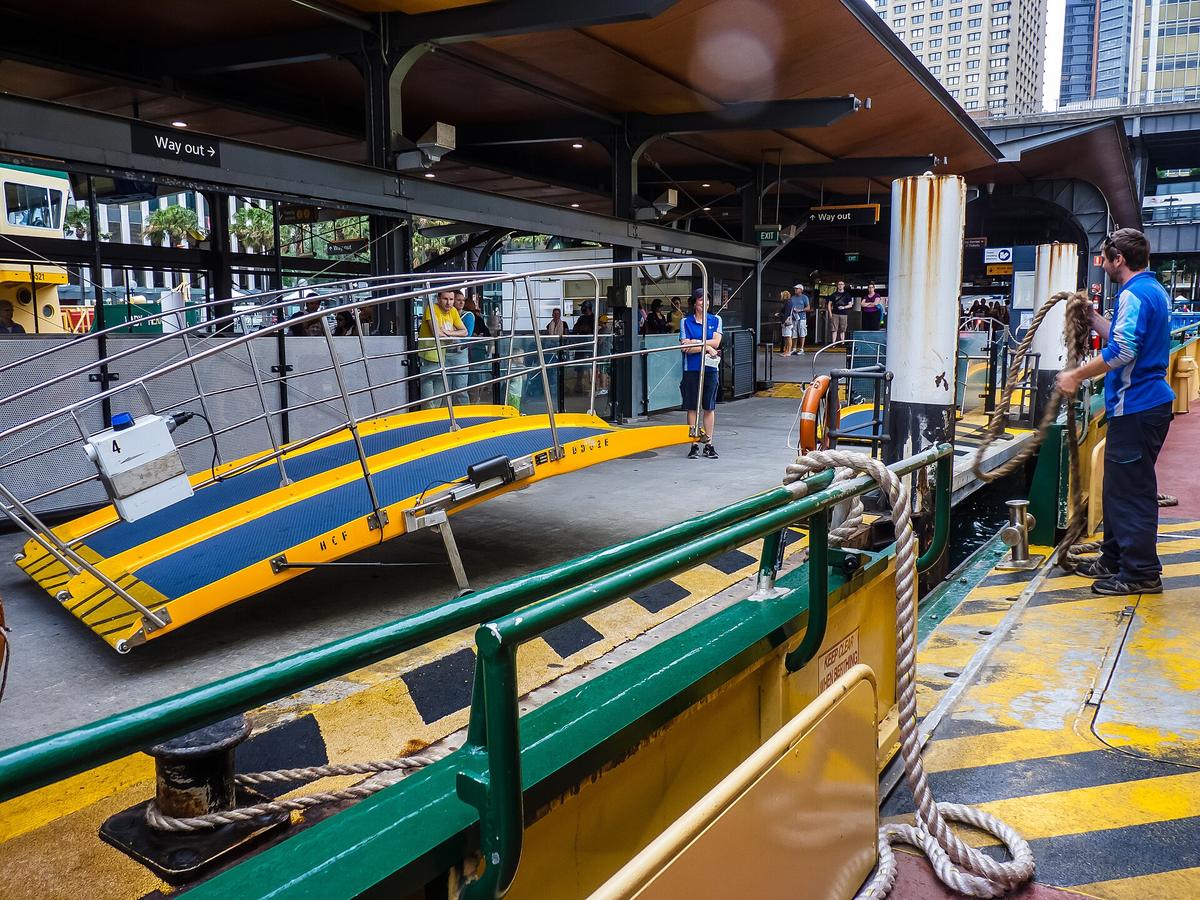
Of the 38 wharves, 36 are wheelchair accessible. The two you cannot use are Rydalmere and Balmain West. The Manly Ferry is accessible only when a Freshwater class vessel is in service; check the timetable before you travel because the SuperCat class that runs the same route has no wheelchair access and no accessible toilet. The Emerald and RiverCat classes are both accessible and have toilets on board. Boarding uses a staff-deployed gangway. At low tide the ramp angle at some wharves can exceed the 1:14 standard, so ask the crew for a slower deployment if the slope looks steep. Hearing loops are fitted at Circular Quay, Manly, and Barangaroo ticket offices only. Manly Beach itself has a sand wheelchair hire service run through the Manly Andrew 'Boy' Charlton Aquatic Centre on (02) 9976 1480. Book 48 hours ahead. The accessible matting runs from October to April, but its length varies with the tide, so call the day before to confirm conditions.
Trains: Step-Free but Not Problem-Free
The 146 step-free stations out of 170 mean you can reach most suburbs. Staff deploy boarding ramps at all accessible stations with no pre-booking needed. The maximum gap at accessible platforms is 40 mm horizontal and 12 mm vertical, which a standard wheelchair clears easily. Quiet carriages are on carriages 1 and 8 of the 8-car Warah A and B sets and carriages 4 and 5 of the 8-car Millennium sets. Use them if noise sensitivity is an issue. Accessible toilets with adult change facilities are at Central, Town Hall, Wynyard, Circular Quay, Bondi Junction, Redfern, Strathfield, Parramatta, Epping, Hornsby, Chatswood, Hurstville, Sutherland, Blacktown, Penrith, Liverpool, Campbelltown, and Olympic Park. The catch is the Sydney Airport station access fee. The adult Opal gate fee is $16.68 in 2026. That is on top of the fare. The concession and child fee is $14.92. Because the Opal daily cap for 2026 is $18.70 for adults and $9.35 for concession holders, a single trip from the airport will blow almost the entire daily cap. Land at the airport, pay the $16.68, and then travel free for the rest of the day on trains, buses, ferries, and light rail. The weekly cap is $50.00 for adults and $25.00 for concession holders. If you arrive on a Monday, that airport fee stings less because your remaining days cost nothing after the cap is reached.
Buses: The Steep-Street Bypass
Every route-service bus has a manual flip-out ramp at the front door that the driver deploys on request. One wheelchair bay per bus, and it takes priority over prams. Automated next-stop announcements with both audio and visual cues run on every route. Hearing loops are not fitted on buses, so carry a personal amplifier if you rely on one. The real value of the bus network is its ability to skirt the worst inclines. The Rocks is a maze of steep pedestrian routes. Erskine Street, Argyle Street, Harrington Street north of Grosvenor Street, and Kent Street north of Erskine Street all exceed a 1:10 slope. Instead of trying to push a wheelchair up these, take a bus along George Street, then switch to a service from the Circular Quay end into Millers Point. These routes stay on flat roads. For Surry Hills, a bus along Cleveland Street bypasses the 1:8 climbs on Albion and Devonshire Streets. The bus is the workaround the tourist maps never print.
Beaches That Deliver on Access
Bondi, Manly, and Cronulla
Three beaches have dedicated wheelchair hire and seasonal matting that runs from the promenade to the water. Bondi Beach is the most equipped. Bondi Pavilion runs an accessible equipment service on (02) 8362 3400. They offer a sand wheelchair with balloon tyres, a beach walker rollator with balloon tyres, and a floating beach wheelchair. All are free. Book 48 hours in advance. The accessible matting extends 110 metres from the promenade to the water and is deployed from late October to late April. There are four accessible parking spaces at Bondi Park car park on Queen Elizabeth Drive. The adult change facility in Bondi Pavilion has a hoist, an adult-sized change table, and a shower. It opens 06:00 to 19:00 daily.
Manly Beach has six accessible parking spaces at North Steyne car park and four at South Steyne. The accessible toilet at the Manly Life Saving Club promenade level has a shower but no adult change table. Call (02) 9976 1480 for the sand wheelchair, beach walker, or floating wheelchair. Cronulla Beach and Freshwater Beach both offer sand wheelchair hire through their surf life saving clubs, with Cronulla also offering a floating wheelchair. Cronulla's matting runs September to April. Freshwater has only a sand wheelchair and two accessible parking spaces. If you want an adult change facility, go to Bondi. If you want a quieter beach with more parking, go to Cronulla.
What to Skip
Skip the eastern walkway of the Harbour Bridge if you are short on time. It is step-free thanks to a lift at the Bridge Stairs on Cumberland Street in The Rocks, and the slope never exceeds 1:20, but it is a long exposed walk with little shade. The view is good. The 40-minute round trip at slow rolling speed is better spent at one of the accessible national park trails instead.
Three National Park Trails That Beat the City Hills
Royal National Park
If the city hills frustrate you, escape to the Royal National Park, Ku-ring-gai Chase National Park, or the Blue Mountains National Park. In the Royal National Park, the Bungoona Path is a 1.1 kilometre sealed return trail with a maximum slope of 1:20. Start at Bungoona Lookout car park, which has two accessible parking spaces. The Forest Path is a longer 4.5 kilometre sealed loop starting at Audley Visitor Centre, with a maximum slope of 1:14. The Audley Visitor Centre has an adult change facility with a hoist and adult change table.
Ku-ring-gai Chase and the Blue Mountains
In Ku-ring-gai Chase, the Kalkari Discovery Trail runs 500 metres sealed and the Bobbin Head Boardwalk runs 800 metres. Both have a maximum slope of 1:20. Neither has an adult change facility. In the Blue Mountains, the Fairfax Heritage Track at Govetts Leap Lookout in Blackheath runs 1.8 kilometres sealed at 1:20. The Three Sisters viewing platform is a 200 metre fully step-free sealed path from the Echo Point car park, which has six accessible parking spaces. The Echo Point visitor centre has an adult change facility. The Prince Henry Cliff Walk section between Echo Point and Katoomba Cascades runs 1.5 kilometres one way at 1:14. These trails offer genuine wilderness without the steep-street anxiety of the city centre.
The Opera House and the Harbour Bridge
Accessing the Sydney Opera House is straightforward. Enter through the Box Office entrance on the Lower Concourse level. Lifts connect to all foyers and performance venues. Wheelchair seating varies by venue: 24 spaces in the Concert Hall, 12 in the Joan Sutherland Theatre, four in the Drama Theatre, four in the Playhouse, four in the Studio, and two in the Utzon Room. All venues have T-coil compatible hearing loops. Auslan-interpreted performances run four to six times per year, and audio-described performances run six to eight times per year. Check sydneyoperahouse.com/access for the schedule. Companion Card is accepted for all performances; the companion ticket is free. Accessible parking requires pre-booking at the Wilson Opera House Car Park on 2 Macquarie Street by calling (02) 9247 7599. There are 12 spaces.
The Harbour Bridge Pylon Lookout is not wheelchair accessible. It has 87 steps and no lift. BridgeClimb requires climbing unaided and has no hearing loop. Skip both. The pedestrian walkway on the eastern side is step-free and has smooth concrete, but it is a means of crossing the harbour, not a destination in itself.
What It Costs and How the Companion Card Helps
The NSW Companion Card is issued by the NSW Government Department of Communities and Justice. If you have a significant and permanent disability that requires attendant care support, you qualify. The companion travels for free on Sydney Trains, Sydney Buses, Sydney Ferries, and Sydney Light Rail when you use your Opal card. The same free admission applies at participating venues. The 2026 Opal daily cap of $18.70 for adults and $9.35 for concession holders means even without a Companion Card, a single journey from the airport plus any other travel that day will push you to the cap, and then you stop paying. The weekly cap of $50.00 for adults and $25.00 for concession holders means a week of unlimited public transport costs less than a single taxi ride from the airport to the city. Load an Opal card at any station or convenience store. Do not use a credit card tap on the airport gate; the system charges the same $16.68 fee, but refunding it later is bureaucratic.

_03.jpg)
| Beach | Book On | Wheelchair Types | Matting Season | Adult Change Facility |
|---|---|---|---|---|
| Bondi Beach | (02) 8362 3400 | Sand wheelchair, beach walker, floating wheelchair | Late October to late April; matting 110 m long | Yes: hoist, adult-sized change table, shower at Bondi Pavilion |
| Manly Beach | (02) 9976 1480 | Sand wheelchair (Hippocampe), beach walker, floating wheelchair | October to April; length varies with tide | No adult change table; accessible toilet and shower at Manly Life Saving Club |
| Cronulla Beach | (02) 9523 6066 | Sand wheelchair, floating wheelchair | September to April | No adult change facility; accessible toilet and shower at Cronulla Surf Life Saving Club |
Who Sydney’s Wheelchair-Accessible Routes Suit and Who They Do Not
Sydney’s wheelchair-accessible routes suit a wheelchair user who is comfortable with public transport, willing to plan routes around the light rail and ferry network, and prepared to book beach equipment two days ahead. They suit someone who wants national park trails over harbour bridge climbs. They do not suit a manual wheelchair user who cannot manage a 1:14 ferry gangway slope at low tide. They do not suit someone who expects every street in The Rocks to be rollable. And they do not suit anyone who thinks the Harbour Bridge Pylon Lookout is worth the 87 steps. It is not.
Frequently Asked Questions
Can I take a wheelchair on the Manly Ferry?
Yes, but only if the service is operated by a Freshwater class vessel. The SuperCat class on the same route has no wheelchair access and no accessible toilet. Check the timetable before you go. The accessible wharves at Circular Quay and Manly have staff-deployed gangways.
How do I get from Sydney Airport to the city in a wheelchair?
Take the train from the airport station. The station is step-free and staff deploy boarding ramps on request. The adult gate fee is $16.68 in 2026, which counts toward the daily Opal cap of $18.70. A single airport trip plus any other travel that day will max out the cap, so you ride free for the rest of the day.
Are there beaches with beach wheelchair hire outside summer?
Yes, but with limits. Bondi Beach deploys its accessible matting from late October to late April. Cronulla Beach deploys from September to April. Outside those windows the matting is removed, but wheelchair hire services still operate if you call 48 hours ahead. You will need to cross loose sand to reach the water without the matting.
Which Sydney Opera House venue has the most wheelchair seating?
The Concert Hall has 24 wheelchair spaces and 24 companion seats. The Joan Sutherland Theatre has 12 spaces and 12 companion seats. All six performance venues have hearing loops. Companion Card is accepted for all performances with a free companion ticket.
What is the steepest street in Sydney's CBD?
King Street between Clarence Street and York Street has a slope of 1:6.5, which is 15.4 percent. Avoid it. Also avoid Erskine Street, Argyle Street, Harrington Street north of Grosvenor Street, and Kent Street north of Erskine Street. All exceed 1:10. Use a bus along George Street instead.
Read next
-
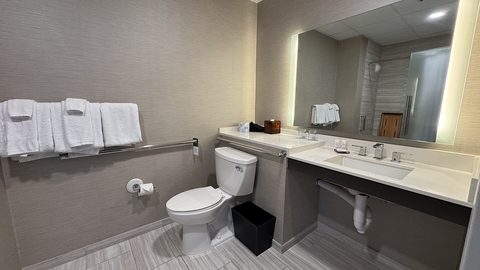 Accessible Hotels in Sydney CBD and the Harbour Without the Surprise
Which Sydney CBD and harbourfront hotels offer genuine wheelchair access where the accessible room is not a downgrade in space or view.
Accessible Hotels in Sydney CBD and the Harbour Without the Surprise
Which Sydney CBD and harbourfront hotels offer genuine wheelchair access where the accessible room is not a downgrade in space or view.
-
 Getting Around Sydney in a Wheelchair Ferries Trains and the Hills
How Sydney's ferries, trains, and light rail work for wheelchair users, and which hillside stations to skip in favour of the bus.
Getting Around Sydney in a Wheelchair Ferries Trains and the Hills
How Sydney's ferries, trains, and light rail work for wheelchair users, and which hillside stations to skip in favour of the bus.
-
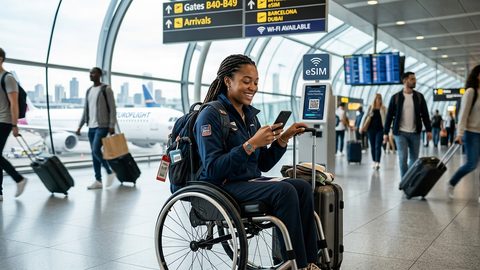 Mobile Data Planning for Wheelchair Users Traveling Abroad With eSIM
Plan mobile data for wheelchair travel abroad, with eSIM setup checks, lift outage updates, transport contacts, repair planning, and offline backups.
Mobile Data Planning for Wheelchair Users Traveling Abroad With eSIM
Plan mobile data for wheelchair travel abroad, with eSIM setup checks, lift outage updates, transport contacts, repair planning, and offline backups.