Navigating New York City with Limited Mobility Beyond the Subway
New York has the least accessible subway of any major ADA city, but the buses, taxis and ferries tell a different story.
- Flag
-

- ISO code
- US
- Population
- 8,804,190
- Currency
- USD
- Timezone
- America/New_York
Only 30 Percent of Subway Stations Have Step Free Access
New York City has the least accessible subway among major American cities with ADA compliance. Only 141 of 472 stations, 30 percent, offered step free access as of July 2025 per the MTA. The rest require stairs. Some have no lift at all. Others have a lift to the mezzanine but not to the platform. A single broken unit can turn an accessible stop into an impassable one for the rest of the day. The MTA aims for 95 percent step free access by 2055. That is 29 years from now. You cannot wait that long. What follows shows you how to move through New York City today without relying on a system that is three decades away from being complete.
The Bus Fleet is 100 Percent Accessible and Often Faster
Why the Bus Wins
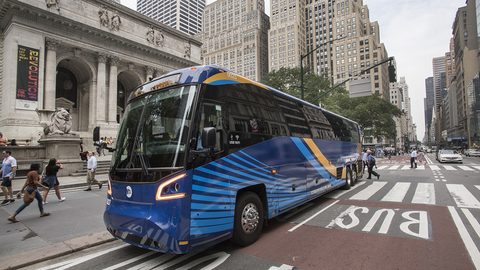
Every MTA bus in the city, every single one across both New York City Transit and MTA Bus Company, has a working wheelchair ramp and a kneeling function as of 2023 fleet data. Board at the front door. The driver deploys the ramp on request. The bus also has securement areas, automated audio and visual stop announcements, and priority seating. Use the MYmta app or Google Maps to plan a route. The grid system makes above ground travel predictable. Most streets run north south or east west. You can see the curb cut at the corner before you get off. That matters. A subway lift outage leaves you stranded in a tunnel. A bus stop problem leaves you on the sidewalk where you can roll to the next block.
Bus Lanes Beat the Tunnel
Dedicated lanes help in Manhattan. The 14th Street busway, the M15 Select Bus Service on First and Second Avenues, and the M23 across 23rd Street run in lanes that bypass car traffic. A bus through Midtown during rush hour can beat the subway when you factor in wait time for a working lift and the longer route to an accessible stop. The flat fare is USD 2.90 paid with a MetroCard or OMNY contactless card. Transfers between buses and subways within two hours cost nothing extra.


Lift Outages: Check Before You Go Underground
The MTA operates 353 lifts across the subway system. In 2024, availability averaged 96.5 percent per MTA performance metrics. That sounds high. It means 12 to 13 units were out on any given day. One of those could be the only lift at your stop. Check live status before you leave your hotel. The MTA website, the MYmta app, and the digital screens inside each stop show real time status. Refresh the app after you board the train. A unit can go out while you ride. If it does, stay on the train to the next accessible stop and double back on a bus or a taxi. Do not descend into a stop with only one exit lift unless you have confirmed it is working.
Which Lines to Use for Step Free Access
The 7 train between Queens and Times Square has step free access at every stop along its Manhattan and Queens portions except Vernon Boulevard for now. The Second Avenue Q line from 96th Street to 72nd Street is fully accessible. The L train across 14th Street has lifts at most stops. The A, C, and E lines under Eighth Avenue have accessible stops at key points: 14th Street, 34th Street, 42nd Street Port Authority, 59th Street Columbus Circle, and 125th Street. Use the MTA map with wheelchair symbols, available on the MTA website. You can also pull a paper version from any station booth. The symbol means step free from street to train, not step free from the mezzanine to the platform. The MTA has different symbols for those two conditions. Look for the one with the full wheelchair icon.
Yellow and Green Taxis: Dispatch a WAV and Get One Within 10 Minutes
Hail or Call a WAV
New York City requires 50 percent of new yellow taxi medallions issued since 2014 to be wheelchair accessible vehicles. The result is a fleet of 4,499 WAV taxis licensed by the Taxi and Limousine Commission as of June 2025. You can hail them on the street. If you wave your hand and a yellow cab with a decked rear seat stops, that driver is required by law to accept your fare. The accessible dispatch rule means every yellow and green taxi base must connect you to a WAV within 10 minutes when you call. Use the TLC Accessible Dispatch service by calling 311 or using the Curb app. The meter runs the same fare as a standard taxi. No extra charge for the wheelchair accessible vehicle.
Ride-Hail WAVs: Budget More Time
Uber and Lyft operate under a separate requirement. The TLC sets an annual minimum for WAV trip completion rates. The 2024 minimum was 80 percent of requested WAV trips completed within 20 minutes. Request a WAV through the accessibility section of each app. The driver who accepts is supposed to have a ramp or a lift. Wait times vary by neighborhood and time of day. Budget 15 to 25 minutes for an Uber WAV in Manhattan during off peak hours. Budget 30 minutes or more in the outer boroughs at night. The yellow taxi WAV dispatch is usually faster. Keep both options open. When one fails, call the other.
Ferries Are the Easiest Surface Option
NYC Ferry runs six routes from Manhattan to Brooklyn, Queens, the Bronx, and Staten Island. Every ferry landing has a ramp or a gangway. Every vessel has a designated wheelchair area on the main deck. The fare is USD 4.00 per ride. You bring your own tie downs. The ferry avoids every subway lift outage, every bus lane detour, and every broken curb cut. The East River route from Wall Street to Long Island City takes 12 minutes. The Rockaway route from Wall Street to the Rockaways takes an hour and drops you within rolling distance of a beach boardwalk. The Staten Island Ferry is free and runs 24 hours a day. The ferry terminals at Whitehall Street in Lower Manhattan and St. George on Staten Island are fully accessible. Use the NYC Ferry app to buy tickets and check real time schedules.


Common Questions
How do I check if a specific subway station has a working lift right now?
Open the MYmta app or the MTA website lift status page. Both show real time outages. Refresh the app after you board the train, because a unit can break while you are en route.
Can I hail a yellow taxi if I use a wheelchair?
Yes. Any yellow taxi with a rear seat that folds up to create floor space is required by law to accept your fare. If the taxi is not WAV equipped, wave for the next one. You can also call 311 or use the Curb app to dispatch a wheelchair accessible vehicle directly.
Do all MTA buses really have working ramps?
Yes. Every MTA New York City Transit and MTA Bus Company bus is equipped with a ramp and a kneeling function as of 2023 fleet data. If a ramp is not deployed, ask the driver. The driver is required to deploy it.
How do I book wheelchair seating at a Broadway show?
Join the TDF Accessibility Program at tdf.org. Call (212) 912-9770 to book. Ask which performances have wheelchair seating available, whether the assistive listening system is infrared or induction loop, and where the accessible entrance is located.
What happens to sidewalks after snow?
Property owners are required to clear sidewalks within 4 hours of a storm if snow stops between 7 a.m. and 5 p.m., or by 11 a.m. the next day if it stops overnight. Snow piled at curb cuts can block crossings for days to weeks. The city fines owners who do not clear snow, but many sidewalks remain impassable after a major storm.
Are all curb cuts in New York City ADA compliant?
New York City required curb cuts at all new and reconstructed sidewalks starting with Local Law 57 of 1972. The NYC DOT reports 100 percent of corners have curb ramps as of 2023. However, many of those ramps do not meet current ADA slope and detectable warning standards, and the city is upgrading them on an ongoing basis.
What is the fastest accessible way to get from Midtown Manhattan to JFK Airport?
The fastest option is a yellow taxi WAV or a for hire vehicle WAV. The A train to Howard Beach and the AirTrain are accessible but require two lift rides and a 10 minute AirTrain ride. Budget 60 minutes by taxi in light traffic and 90 minutes by subway.
Read next
-
 Accessible Hotels in New York City ADA Rooms and the Real Room Size
Which New York City hotels offer ADA rooms with real turning space and a usable roll-in shower, not just the legal minimum square footage.
Accessible Hotels in New York City ADA Rooms and the Real Room Size
Which New York City hotels offer ADA rooms with real turning space and a usable roll-in shower, not just the legal minimum square footage.
-
 Getting Around New York City in a Wheelchair When the Bus Is the Answer
Why New York City's bus network is the most reliable wheelchair transport option, and when the subway's elevator network is worth the risk.
Getting Around New York City in a Wheelchair When the Bus Is the Answer
Why New York City's bus network is the most reliable wheelchair transport option, and when the subway's elevator network is worth the risk.
-
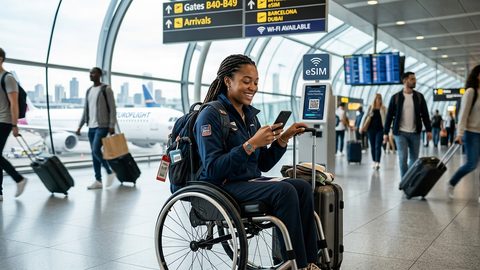 Mobile Data Planning for Wheelchair Users Traveling Abroad With eSIM
Plan mobile data for wheelchair travel abroad, with eSIM setup checks, lift outage updates, transport contacts, repair planning, and offline backups.
Mobile Data Planning for Wheelchair Users Traveling Abroad With eSIM
Plan mobile data for wheelchair travel abroad, with eSIM setup checks, lift outage updates, transport contacts, repair planning, and offline backups.