Finding a Wheelchair Accessible Hotel in Barcelona
How Barcelona's 1992 Paralympic legacy shaped hotel accessibility and the exact measurements to verify before booking an adapted room.
Finding a Wheelchair Accessible Hotel in Barcelona
Barcelona built a lot for the 1992 Paralympic Games. Most of the city's hotel stock predates that trigger. The word 'accessible' on Booking.com or Expedia often means a ramp that is too steep or a lift that stops four steps short of your room. The 1992 mandate required step-free access in all new construction. The Gothic Quarter and most of Eixample were built before 1910. That gap between legal requirement and actual usability is where you get tripped up.
A handful of Barcelona hotels genuinely comply. You need to know what measurements to demand before you hand over a credit card, and which neighbourhoods to target and which to skip. The single question to answer: which Barcelona hotels built or renovated after 1992 actually deliver a step-free room with a usable bathroom, and what numbers must you verify in writing before you arrive?
The answer is not a brand or a star rating. Demand a set of dimensions in an email. Use the shortlist of post-Paralympic hotels audited by a third party. The rest is marketing.

The Building Problem: Pre 1910 Stock, Protected Facades, and Phantom Lifts
Where False Claims Breed
Two neighbourhoods produce the majority of false accessibility claims: the Gothic Quarter and the Eixample. In the Gothic Quarter, buildings predate 1900, facades are protected, and there is no space for a lift shaft. The failure mode is a doorway with 2 to 5 steps. Hotels call themselves accessible because they have a ground-floor room. They skip the step at the door. In Eixample, the failure mode is grander. Doorways have 3 to 8 steps from the street to the lobby. Lift retrofits are common. They often stop at a mezzanine, leaving 4 to 6 steps up to the first-floor rooms. A hotel that says 'lift access to all floors' may still require you to climb stairs just to reach that lift.
Neighbourhoods That Work
Three neighbourhoods solve this problem. Sant Martí is post-1992 development with wide boulevards and step-free corners. Diagonal Mar is purpose-built after 2000; every building is step-free. Eixample, despite its old buildings, has the grid-street advantage: wide pavements and most corners ramped since the 2010s. The catch is that an Eixample address does not guarantee a step-free hotel. You still check the entry point.
Poble Sec and parts of Gràcia are partial solutions. Poble Sec is flat and has a step-free metro at Paral·lel. Older buildings in Gràcia are hilly with narrow streets and step-only access. Barceloneta has ground-floor accessibility but almost no lifts to upper floors. Skip Barceloneta unless you book a ground-floor room and verify the doorway.
What You Must Verify Before You Book
The Spanish Standard
The Spanish standard for an accessible room, UNE 170001-1 of 2007, sets these numbers. Door width: 80 cm minimum. Ensuite door width: also 80 cm. Turning circle: 150 cm in diameter. Bed height from floor to mattress top: 45 to 55 cm. Grab rails on both sides of the toilet: a fold-down rail on the wall side, a fixed rail on the open side. The shower must be roll-in with a fold-down seat, a floor gradient of 0 to 2 percent, and a single-lever mixer at 90 to 100 cm height. Emergency alarms must include a pull cord at 30 to 40 cm from the floor in the bathroom and beside the bed.
Ignore the Filters
Do not rely on booking-site filters. Booking.com offers 12 accessibility filters in Barcelona, including 'roll-in shower', 'toilet with grab rails', and 'entire unit wheelchair accessible'. All of them are self-declared by the hotel. No third party verifies them. Expedia has the same model with 8 filters. The filter 'wheelchair accessible' on Booking.com returns properties with a single step at the doorway in 15 to 30 percent of listings. That is the error rate. You need email verification.
The Five Questions
Send these five questions to every hotel before you pay a deposit. One: Is there any step, lip, or threshold higher than 2 cm between the street and my room, including the lobby, lift, and corridor? Two: Does the shower have a lip or step higher than 2 cm, and is there a fold-down seat fixed to the wall? Three: What are the internal lift car dimensions in centimetres, and what is the door opening width? Four: What is the exact height from the floor to the top of the mattress, not including bedding? Five: Is there a designated accessible parking space, what is its width, and is it within 50 metres of a step-free entry point?
Four Hotels That Pass the Test and One That Does Not
Hotel ILUNION Barcelona
Book this one first. The ILUNION chain is owned by Fundación ONCE, Spain's national blind people's organisation. Every property is audited by that foundation. The Barcelona hotel has 8 accessible rooms with step-free entry, roll-in showers, door width 80 cm, and a 150 cm turning circle. The on-site audit happened in 2023. The downside: the hotel is in Sant Martí, near the Port Olímpic. That is not the Gothic Quarter or the heart of the old city. You trade location for certainty. Make that trade.
Hotel SB Icaria Barcelona
Also in the Port Olímpic zone. Six accessible rooms, step-free from the street, roll-in showers, and a pool hoist. Verified by direct hotel communication in 2024. The location is flat, post-1992, and well connected to metro L4 at Ciutadella and L1 at Marina. The downside mirrors ILUNION: you are staying in the newer part of the city. If you are here for the beach, the port, and the conference centres, this is your hotel. If you want to wake up in the Gothic Quarter, take the metro.
Hotel W Barcelona
Ten accessible rooms, step-free entry, roll-in showers, door width 85 cm. The property has a published accessibility statement from 2024. The W sits at the tip of Barceloneta, built in 2009 to modern construction standards. The downside is price and location. It is expensive. Barceloneta is not a step-free neighbourhood for anyone who wants to go beyond the ground floor. The hotel itself functions. The surrounding streets and beach access are uneven. Use taxis.
Hotel Catalonia Barcelona Plaza
Two accessible rooms with step-free entry from the Plaça Espanya side. The lift door width is 70 cm, below the 80 cm standard. The turning circle is 140 cm, also below standard. The measurements were provided by a guest in 2022, not by the hotel. This property is a compromise. It has a functional step-free entry from one side. The room dimensions fall short. Skip it if you use a power wheelchair. For manual chair users who can manage tighter turns, it may work. The risk is yours.
Hotel Barcelona Universal
Four accessible rooms, step-free entry via a side ramp with a gradient of 8 percent. The recommended maximum is 6 percent. Door width is 78 cm, 2 cm short of the standard. A guest took these measurements in 2023. The ramp gradient makes independent ascent difficult in a manual chair. The door width may be tight for larger chairs. This hotel is a demonstration of why self-declaration fails. The hotel calls itself accessible. The measurements say otherwise. Skip it. If Barcelona’s self-declared access falls short, Berlin’s cobblestone streets will catch you just as fast.


Getting Around: What Actually Works
Metro: Line by Line
The metro network has step-free stations. Not all lines are equal. As of 2024, all 18 stations on metro L2 are step-free. Metro L4 has 20 of 22 stations step-free; Verdaguer and Maragall are the gaps. Metro L5 has 21 of 26 step-free, missing Plaça de Sants (L5 platform, lift gap to L1 connection), Verdaguer (L5 platform step-free, L4 not), Virrei Amat, Vilapicina, and Horta. Metro L1 has 24 of 30 step-free. Plaça de Sants (L1 platform, lift gap to L5 connection), Espanya (L1 platform, partial step-free), and Clot (L1 platform, lift under construction as of 2024) are the gaps. Metro L3 has 22 of 26 step-free, with Vallcarca, Liceu, and Drassanes as the gaps. Liceu and Drassanes sit in the Gothic Quarter. If you stay there, the metro is not your friend.
Buses and Taxis
The entire TMB bus fleet is low-floor with manual ramps, kneeling function, and wheelchair bay dimensions of 130 by 75 cm. Every route. Every bus. As of 2024. The accessible taxi fleet is roughly 300 vehicles. Book through the Taxi Amic app. They have ramp or lift access and door widths of 75 to 90 cm.
Hearing Loops
Hearing loops are rare in Barcelona hotels. They exist in conference rooms at some 4-star-and-above business hotels. They are not in guest rooms. The Spanish standard is a magnetic induction loop to IEC 60118-4, marked with a blue T symbol where installed. If you rely on a hearing loop, ask the hotel directly whether one is in the bedroom, not just in the lobby or meeting room. The answer will almost certainly be no.
The Honest Caveat
The hotels that genuinely comply are in the newer parts of the city. The Port Olímpic zone, Diagonal Mar, and Sant Martí are your safe zones. The old city, the Gothic Quarter, and most of Eixample are not. You can find a working room in Eixample. You must verify every measurement yourself. The 1992 Paralympic Games mandated step-free access for new builds. That mandate did not apply retroactively. It did not create a culture of third-party verification. You are the quality control. That is the honest truth.
Common Questions
What is the single most reliable way to verify a Barcelona hotel is step free?
Email the hotel the five questions listed above. Booking.com and Expedia filters are self-declared and have a 15 to 30 percent error rate. A written answer that gives specific measurements is the only thing you can trust.
Is the Gothic Quarter a realistic option for wheelchair users?
No, unless you find a rare ground-floor unit in a building built after 1992. The neighbourhood is full of buildings predating 1900 with protected facades, no space for lift shafts, and entry steps of 2 to 5 risers. Metro L3 has no lift at Liceu or Drassanes, the two stations that serve the area.
How many accessible rooms does the average Barcelona hotel have?
The hotels worth your time have between 2 and 10 accessible rooms. Hotel ILUNION Barcelona has 8, Hotel SB Icaria has 6, Hotel W Barcelona has 10, and Hotel Catalonia Barcelona Plaza has 2. A hotel with a single accessible room should raise a flag: the room may be a converted standard room, not purpose-built.
What door width should I demand in an accessible hotel room in Spain?
80 cm minimum, per the Spanish UNE 170001-1 of 2007 standard. Ensuite doors must also be 80 cm. A door width of 78 cm, as at Hotel Barcelona Universal, is too tight for many power wheelchairs.
Can I rely on Barcelona's metro for step-free travel?
Yes, but only on specific lines. Metro L2 is fully step-free. Metro L4 and L5 have gaps. Metro L3 is the worst, with 4 of 26 stations lacking lifts, including the ones under the Gothic Quarter. Check the TMB accessibility page before you travel, updated December 2024, and plan your route around the stations listed as step-free.
Read next
-
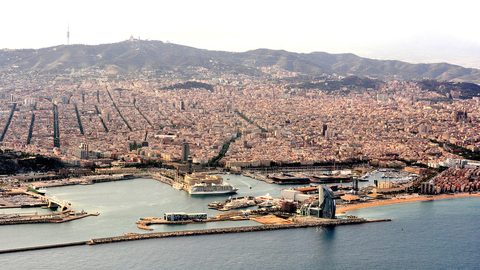
 Getting Around Barcelona for Disabled Travellers Metro Lifts and the Cobbles
A realistic guide to Barcelona's accessible transport, from frequently broken Metro lifts to the cobbled streets of the Gothic Quarter.
Getting Around Barcelona for Disabled Travellers Metro Lifts and the Cobbles
A realistic guide to Barcelona's accessible transport, from frequently broken Metro lifts to the cobbled streets of the Gothic Quarter.
-
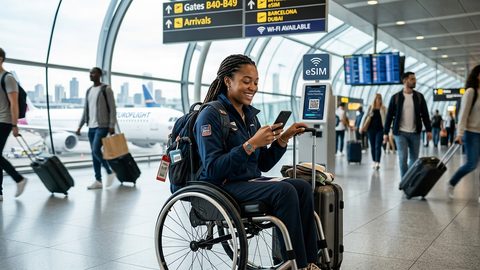 Mobile Data Planning for Wheelchair Users Traveling Abroad With eSIM
Plan mobile data for wheelchair travel abroad, with eSIM setup checks, lift outage updates, transport contacts, repair planning, and offline backups.
Mobile Data Planning for Wheelchair Users Traveling Abroad With eSIM
Plan mobile data for wheelchair travel abroad, with eSIM setup checks, lift outage updates, transport contacts, repair planning, and offline backups.