Wheelchair Rail Travel in Europe Booking Assistance and Connections
A practical guide to Wheelchair Rail Travel in Europe Booking Assistance and Connections.


Understanding your legal right to assistance across Europe
Rail travel across Europe with a wheelchair begins with a single, powerful guarantee. Under EU Regulation 2021/782, every passenger with a disability or reduced mobility holds the right to free assistance when travelling by train. This covers help boarding and alighting, transferring between services, and on-board support where available. The regulation applies across all member states and places a clear obligation on railway undertakings and station managers to provide this service without charge.
The standard rule for booking that assistance is straightforward: you need to give at least 24 hours' notice before your scheduled departure. If you arrive without a reservation, the staff must still make every reasonable effort to help you. That fallback is a legal duty, not a courtesy, though relying on it means accepting uncertainty that a booked slot removes entirely.
One important timing detail affects a small group of countries. Eight EU member states were permitted to apply a longer 36-hour pre-notification period. Those countries are Bulgaria, Czechia, Croatia, Germany, Hungary, Latvia, Romania, and Denmark for cross-border services to Germany. This exemption is not permanent. It expires on 30 June 2026. If you are planning a journey that touches any of those nations close to or after that date, check directly with the European Commission's rail passenger rights page or the relevant national operator to confirm whether the 24-hour standard now applies in your departure country.
Booking assistance in France with SNCF and Assist’enGare
France operates a centralised assistance system called Assist'enGare, managed by SNCF. The service is free and can be booked from 90 days before travel up to 24 hours before departure. If you miss that window, assistance is not guaranteed, so treating the 24-hour mark as a firm deadline is the safer approach. You can reach the booking team by telephone daily between 08:00 and 20:00 on 32 12 from within France, or on +33 (0)9 72 72 00 92 from abroad. An online reservation form is also available.
On the day of travel, wheelchair users must arrive at the designated station assistance meeting point at least 30 minutes before departure. If your journey involves a Eurostar service from London, that requirement extends to 60 minutes. Assistance staff will carry one piece of luggage weighing up to 15 kg. If you travel with more, you will need to manage the additional bags yourself or arrange a companion to help.
Not every wheelchair fits every train, and SNCF publishes clear dimensional limits. Your chair must stay within 70 cm in width, 120 cm in length, and 145 cm in height, with a turning diameter of 150 cm. The combined weight of the occupant and luggage must not exceed 300 kg for electric wheelchairs or 200 kg for manual chairs. Measure your equipment against these figures before booking, because exceeding them can mean being unable to board.
Germany’s Mobility Service Centre and the 36-hour exemption
Deutsche Bahn runs its free assistance programme through the Mobility Service Centre, known as the MSZ. The service covers boarding, changing trains, and alighting at almost 300 stations across the country. For domestic German journeys, you should make your request by 20:00 the day before travel. For international journeys, the minimum is at least 24 hours in advance. The centre is reachable by telephone on +49 (0)30 65 21 28 88, with opening hours of Monday to Friday from 06:00 to 22:00, and Saturday, Sunday and public holidays from 08:00 to 20:00. You can also email msz@deutschebahn.com or use the barrier-free online form at msz.bahnhof.de.
Germany is one of the countries that held the 36-hour exemption mentioned earlier. Until 30 June 2026, that longer notice period may still apply in certain situations. The practical advice is to contact the MSZ as early as you can, particularly for cross-border trips, and to ask explicitly about which notice period governs your specific departure. After mid-2026, the standard 24-hour rule should be uniform, but verifying directly with Deutsche Bahn remains the only way to be certain on any given travel date.
Italy, Spain and the shorter-notice options
Italy and Spain offer two of the most flexible booking windows in Europe, which can be a decisive advantage when plans change at short notice. In Italy, Trenitalia's free assistance is managed by RFI through its Sala Blu offices. You can request help via the SalaBlu online service, the Sala Blu+ app, the toll-free number 800 90 60 60 inside Italy, or +39 02 32 32 32 from abroad. Email requests are also accepted. The standout detail is the deadline: you can book up to 6 hours before departure. That narrow window gives you room to adjust plans that would be locked in elsewhere a full day ahead.
Spain's Adif Acerca service splits its offering across two station categories. At 70 stations with permanent service, you can request assistance up to 30 minutes before departure. At a further 76 stations with ad-hoc service, the deadline is 12 hours before departure. To book, call 91 774 40 40, email oca.asistenciapmr@adif.es, or use Renfe's freephone 91 320 320. When planning a Spanish itinerary, identify which category your departure station falls into well before you travel. A station with only ad-hoc service demands the same advance planning discipline as the French or German systems, while a permanent-service station gives you exceptional last-minute flexibility.
Switzerland and Austria compared
Switzerland and Austria sit at different points on the advance-notice spectrum, and understanding the contrast helps when linking journeys across central Europe. Swiss Federal Railways, SBB, operates the Contact Center Handicap, which provides free boarding and alighting assistance across all Swiss public transport. For domestic trips, you need to request help at least 1 hour in advance. That is the shortest standard notice period in the research. For international journeys, the requirement rises to at least 24 hours. You can call 0800 007 102 free from within Switzerland, or +41 800 007 102 from abroad, or use the online AMO system at swisspass.ch/handicap.
Austria's ÖBB Mobility Service Centre asks for more lead time. Domestic journeys require 12 hours' notice, or a booking by 18:00 the day before if your train leaves before 09:00. International journeys need 24 hours' notice. The centre is available daily from 06:00 to 21:00 on +43 (0)5 1717 5, and an online registration form exists. If you are crossing between Switzerland and Austria, the Swiss domestic 1-hour rule does not carry over. The moment your trip becomes international, the 24-hour standard applies on both sides, so plan the cross-border leg first and let the domestic connections fall in around it.
Eurostar and the cross-Channel wheelchair fare
Eurostar operates under its own specific rules that layer on top of the EU regulation. Wheelchair spaces and ramp assistance must be pre-booked at least 24 hours before travel. The dimensional limits for your chair are 70 cm wide and 120 cm long, with a maximum combined weight of 300 kg. However, that weight limit drops to 250 kg at all French stations and at Duisburg and Aachen in Germany. If your journey passes through any of those locations, the lower figure is the one that matters.
Wheelchair users travel in Eurostar Plus or Eurostar Premier class at a fixed wheelchair fare. Electric wheelchairs and mobility scooters are permitted, but they must not use combustible fuels, and you cannot charge them on board or in stations. The 60-minute arrival requirement at London that SNCF references for Eurostar connections applies here too. Build that hour into your schedule, because the assistance meeting point and the platform can be a significant distance apart at St Pancras International.
Building a multi-country rail itinerary with confidence
Linking several countries by rail with a wheelchair means managing a patchwork of deadlines, not a single rule. The EU's 24-hour standard provides a common baseline, but the exceptions in Germany and the shorter windows in Italy, Spain and Switzerland mean your booking sequence matters. A practical approach is to work backwards from the leg with the longest notice period. If your trip includes a German cross-border segment, that 36-hour or 24-hour requirement should be the first call you make. Once that is locked, book the French 24-hour leg, then the Austrian 12-hour or Swiss 1-hour domestic connections.
Dimensional limits also vary. SNCF and Eurostar both publish 70 cm by 120 cm maximum footprints, but the weight tolerances differ. A chair that is fine for a French TGV might exceed the 250 kg limit at a Eurostar stop in Lille or Paris. Measure once and carry those numbers with you. When you call each operator, state your chair's width, length, height, turning circle and combined weight before you give your travel dates. That lets the agent confirm compatibility immediately rather than after you have built an itinerary that cannot be honoured.
Every telephone number, opening hour and weight limit mentioned here can change. Before you book, visit the operator's own accessibility page. For SNCF, check the Assist'enGare booking portal. For Deutsche Bahn, consult the MSZ FAQ. For Trenitalia, look at the Sala Blu section. For Renfe, review the Adif Acerca page. For SBB, use the Contact Center Handicap site. For ÖBB, check the Mobility Service page. For Eurostar, read the accessible travel and wheelchair fares pages. A five-minute verification on the morning you book is worth more than any static reference.
Sources and verification
- europa.eu — Research source checked for this guide
- eur-lex.europa.eu — Research source checked for this guide
- amt-autoridade.pt — Research source checked for this guide
- sncf-voyageurs.com — Research source checked for this guide
- garesetconnexions.sncf — Research source checked for this guide
- garesetconnexions.sncf — Research source checked for this guide
Read next
-
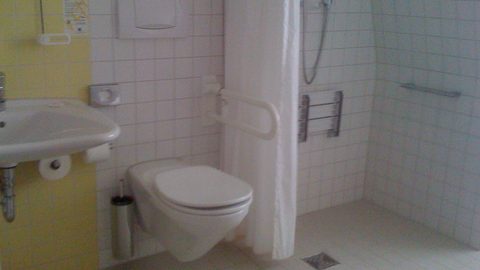 How to Verify an Accessible Hotel Room Before You Pay
A practical guide to How to Verify an Accessible Hotel Room Before You Pay.
-
 Flying With a Power Wheelchair A Damage Prevention Checklist
A practical guide to Flying With a Power Wheelchair A Damage Prevention Checklist.
-
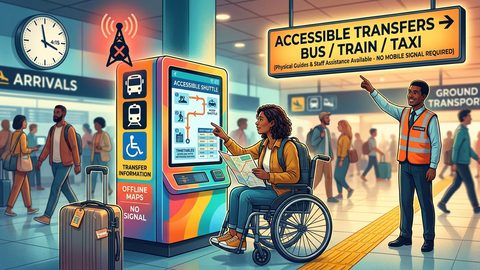 Accessible Airport Transfer Planning When Mobile Service Fails
Plan a wheelchair-accessible airport transfer with confirmed vehicle details, clear pickup points, offline addresses, and backup contacts if mobile service fails.
-
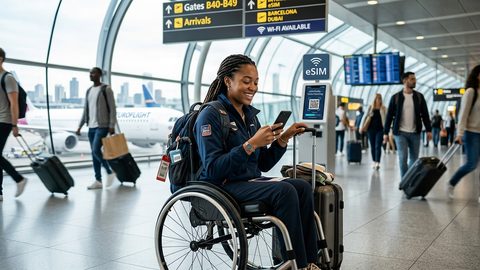 Mobile Data Planning for Wheelchair Users Traveling Abroad With eSIM
Plan mobile data for wheelchair travel abroad, with eSIM setup checks, lift outage updates, transport contacts, repair planning, and offline backups.