Tokyo Accessible Transport and the Station Attendant Ramp System
How Tokyo's station attendant ramp service works in practice, from requesting assistance to navigating the busiest interchange stations.
The Station Attendant Ramp System is the Actual Backbone of Tokyo Wheelchair Transit
What The System Actually Is
Every JR East, Tokyo Metro, and Toei Subway stop in the Tokyo 23 wards has a step‑free route from train to street. That is 100% coverage, verified by each operator in 2025. But the system depends on a human being carrying a 1.4‑metre portable ramp to your train door, not on a permanent bridge. The official names vary. JR East calls it Dantai shōgai sha go annai. Tokyo Metro and Toei Subway call it O tetsudai service. Every operator provides it at no extra cost. None of them require advance notice for a single wheelchair user arriving at a staffed gate. You do not need to reserve. You do need to know the procedure, because the ramp disappears at unstaffed gates and the coordination at a hub like Shinjuku can fail if you do not enter the right way.
How The Door‑To‑Door Procedure Runs
Enter through any staffed ticket gate. Tell the attendant you need boarding assistance. They radio the platform staff, who note the car number you board. At your destination, the same operator's staff meet that exact car door. The ramp deploys across the platform gap, which JR East standardises at a maximum of 0.07 m horizontal and 0.05 m vertical at any location that uses a portable ramp. The ramp itself bridges a step up to 0.17 m on JR East and 0.15 m on Tokyo Metro. The gradient never exceeds 1:12 on JR East. From the platform, you follow tactile paving to a lift. Every stop on the Yamanote Line has a lift connecting platform to ticket gate. Every JR East location in the 23 wards does. The typical lift car is 1.4 m wide and 1.35 m deep. The door clear opening is a minimum of 0.80 m.
The Interchange Problem At Shinjuku And Tokyo Station
Changing operators is the failure point. At Shinjuku you switch between JR East lines or between JR East and the Toei Subway. The ramp service does not cross operators. You call the ramp from JR staff when you arrive. You debark, take the lift to the concourse, then enter the Toei gate and request a second ramp from Toei staff. The process repeats. Tokyo Station works the same way. Budget 15 min for any operator switch. The alternative is to stay on one operator. A single JR East journey on the Yamanote Line stops at 30 locations, all with 100% step‑free access from train to street. If you do not need to change operators, the trip is straightforward.


The Exit Re‑Entry Trap on Tokyo Metro and the 180‑Metre Detour
The Re‑Entry Problem
At 42 Tokyo Metro locations, the lift route from one line to another requires you to exit the ticket gates and re‑enter through separate gates. That means you need a second ramp call for the re‑entry. The longest published lift detour from ticket gate to platform is 180 m, at Kokkai gijidomae Station on the Marunouchi Line platform 1. You cannot avoid that walk. The lift is not blocked. The architectural layout simply puts the lift outside the paid area for that direction. Check the Tokyo Metro barrier‑free route map before travel. The map shows which locations require the exit re‑entry move. If your transfer involves one of those 42, add 10 min.
Platform Screen Doors Are Not An Obstacle
Tokyo Metro and Toei Subway have platform screen doors at 100% of their stops. The JR East Yamanote Line also has them at all 30. For other JR East lines in Tokyo, 78% of stops have screen doors. The doors do not block ramp access. The staff know the alignment and stop the train so the wheelchair‑accessible car door lines up with the screen door. Do not position yourself at a random car. Wait where the platform staff instructed you.
The Unstaffed Gate Problem On JR East
JR East operates some unstaffed gates at smaller locations. If you arrive at one, there is no portable ramp. Walk or roll to the nearest staffed entrance. If you cannot reach it, call the JR East accessibility line at +81 50 2016 1603, English available 10:00 to 18:00 JST. The question to ask: Can you send staff to [station name] gate [number] at [time] with a ramp? This is the failure case. Plan your entry route to avoid unstaffed gates entirely. The advance reservation phone call is recommended for groups of three or more wheelchair users, anyone travelling through an unstaffed gate, or if you use a power chair that the standard ramp dimensions might not accommodate. The standard ramp bridges a 0.17 m step. If your chair cannot handle a 1:12 gradient, request the specific ramp type on the same call.
Lifts at Old Stations and the Bus Backup
When A Lift Exists But The Route Is Long
A stop with a lift is not the same as a stop with a short lift route. The older locations on the Marunouchi and Ginza lines sometimes have lifts that deposit you in a side corridor 80 m from the platform. You can still get through. The accessible toilet maps published by each operator show the exact position. JR East publishes its map at jreast.co.jp/e/barrier-free. Tokyo Metro at tokyometro.jp/en/station/barrierfree. Toei at kotsu.metro.tokyo.jp/eng/barrier_free. Check the map before you travel. If the published lift status shows a green marker, call ahead and ask: Is the lift at [exit number] working today? If not, which is the nearest working lift?
The Bus As Backup
The bus network works when the train does not. Toei Bus operates a 100% low‑floor fleet with a manual ramp. The ramp clear width is 0.80 m. Maximum gradient 1:4. One wheelchair bay per bus, dimensions 1.30 m long by 0.75 m wide. Flag them down on the street. No reservation needed. The ramp deploys at every stop. If the train transfer requires walking 180 m and you cannot do it, take the bus for that segment instead. For a city that makes wheelchair travel genuinely effortless, contrast this with Singapore, where step‑free access is so comprehensive it is often called Asia’s most accessible city.


What the Private Railways Cover and What They Do Not
Tokyu Corporation has 100% step‑free coverage across all 98 stops in the Tokyo 23 wards. Keisei Electric Railway has the lowest coverage among private operators in Tokyo at 82%. If you use Keisei, check the specific location before travel. The gap matters. Tokyu lets you roll through without the exit re‑entry problem on most lines. Keisei may not. The same ramp rules apply: call the operator's location directly. No reservation needed for a single user at a staffed gate.
The Single Question That Prevents the Most Failures
Before you leave your hotel, ask at the front desk: Is the lift at my departure station working? If they cannot confirm, call the station yourself. The number for JR East accessibility inquiries is +81 50 2016 1603, English available 10:00 to 18:00 JST. For Tokyo Metro it is +81 3 3837 7111, English weekdays 09:00 to 17:00 JST. For Toei Subway it is +81 3 3816 5700, same weekday hours. Ask the question: Is the lift at [exit number] working today? If not, which is the nearest working lift? The published maps show lift status but they update on a delay. The phone call gives you the real status. Do that. It takes two minutes and it stops you from arriving at a station with a broken lift and no backup ramp.
Common Questions
Do I need to reserve the portable ramp in advance for a single person trip?
No. JR East, Tokyo Metro, and Toei Subway all provide the ramp with zero minutes minimum notice at any staffed gate. No reservation required. The advance reservation phone call is recommended only for groups of three or more wheelchair users, anyone using an unstaffed gate, or anyone whose wheelchair exceeds the standard ramp dimensions.
What happens when I need to change from JR East to Tokyo Metro at a station like Shinjuku?
The ramp service does not cross operators. Use the JR East ramp to leave the JR East train. Go through the JR East gate. Enter the Tokyo Metro gate and request a second ramp from Tokyo Metro staff. Budget 15 minutes for the operator switch.
Are all Tokyo Metro stations accessible by lift?
All 180 stations have a step‑free route from train to street. However, 42 stations require you to exit the ticket gates and re‑enter through separate gates to change lines. The longest lift detour from ticket gate to platform is 180 metres at Kokkai gijidomae Station.
Can I catch a taxi if the train ramp service is delayed?
Yes. Tokyo has 12,400 wheelchair‑accessible UD taxis. These are Nissan NV200 or Toyota JPN Taxi models with a rear ramp, one wheelchair space and seats for three passengers. The ramp gradient is 1:5. The rear door opening is 0.72 m wide. Book through Uber Japan, GO, or S.RIDE. Flag‑down availability is limited so you should book.
What is the most common thing that goes wrong when using the Tokyo ramp system?
Entering through an unstaffed gate where no ramp is available. JR East operates unstaffed gates at some smaller stations. Always enter through a staffed gate. If you cannot, call the JR East accessibility line at +81 50 2016 1603 before you arrive.
Read next
-
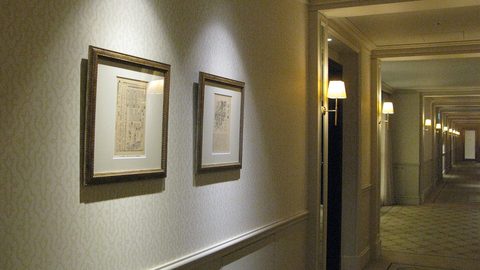
 Accessible Hotels in Tokyo Where the Room Is Big Enough to Turn
Which Tokyo hotels provide enough clear floor space for a wheelchair turn, plus a genuine roll-in shower, not just a compact universal room.
Accessible Hotels in Tokyo Where the Room Is Big Enough to Turn
Which Tokyo hotels provide enough clear floor space for a wheelchair turn, plus a genuine roll-in shower, not just a compact universal room.
-
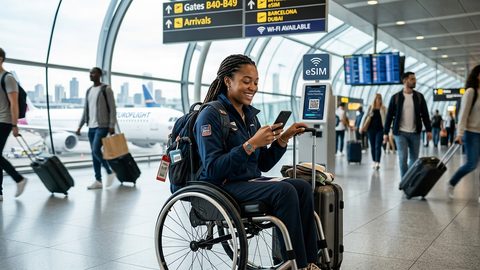 Mobile Data Planning for Wheelchair Users Traveling Abroad With eSIM
Plan mobile data for wheelchair travel abroad, with eSIM setup checks, lift outage updates, transport contacts, repair planning, and offline backups.
Mobile Data Planning for Wheelchair Users Traveling Abroad With eSIM
Plan mobile data for wheelchair travel abroad, with eSIM setup checks, lift outage updates, transport contacts, repair planning, and offline backups.