Getting Around London by Wheelchair or with Limited Mobility
London accessible transport beyond the step-free Tube map: the platform gaps, bus bay conflicts, and kerb problems no journey planner mentions.


The Biggest Myth About London’s Accessible Transport
The most common wrong assumption about this city is that a station with level access guarantees a train you can board. It does not. Of London Underground’s 96 stations where you can reach the platform without stairs, as recorded by Transport for London in their August 2024 Step-free Tube guide, only the route from street to platform is guaranteed to be level. The horizontal gap between platform and train can still exceed 75 mm, which is the maximum for unassisted boarding under the UK Rail Vehicle Accessibility Regulations 2010. If that gap is wider, you need a ramp deployed by staff, and there is no way to know in advance without phoning the operator.
The practical effect: you can roll onto a platform at a location like Bank, with its 14 lifts, the highest number on the network and also the highest failure rate per TfL’s 2023 customer data, and find the train doors sitting 100 mm away from the edge. The train is accessible, the station is accessible, but getting from one to the other requires a staff member you did not book. Book National Rail assisted travel by calling 0800 022 3720, or textphone 0845 60 50 600. Give two hours notice. Turn-up-and-go is available but pre-booking is advised. For Eurostar services from London to France or Belgium, you must book 48 hours in advance.
What the Tube Map Does Not Tell You
Of 272 London Underground stations, 96 are fully accessible from street to platform. The remainder are not. The Elizabeth line and the Docklands Light Railway are different: all 41 Elizabeth line stations and all 45 DLR stations are accessible from street to platform, as of 2024. London Overground is less reliable, with 62 of 113 stations offering level access. Tramlink is 100% accessible at all 39 stops.
The Platform Gap Problem
Even at accessible Underground stops, the platform-to-train horizontal gap threshold for unassisted boarding is 75 mm. The vertical step threshold is 50 mm. If either is greater, you need a ramp carried on all trains and deployed by station staff. You cannot board alone. The only way to confirm the gap for your specific train is to phone the operator and ask: “What is the horizontal gap and vertical step at the platform edge for my train?” and “Is a ramp required to board, and will staff be present to deploy it?”
Lift Failures Are Routine
Bank has 14 lifts and the highest failure rate on the network, according to TfL’s 2023 customer data. A single lift outage can cut off the only accessible route. Always check the TfL Go app or visit tfl.gov.uk/plan-a-journey/step-free-access before you leave. If lifts fail, ask the staff for the alternative accessible route. If no route exists, you cannot use that station that day.
Thameslink Versus The Underground
Thameslink trains, operated by National Rail, follow a stricter standard. All staffed stations have a ramp carried on all trains. The notice period for booking assistance is two hours. The key difference: Thameslink staff are more accustomed to ramp deployment because every station above ground has level boarding or a ramp. The Underground, with its curved platforms and older infrastructure, is less predictable. If you have a choice between a Thameslink route and an Underground route for the same journey, take the Thameslink route.
Black Cabs, Buses, and the Docklands Light Railway
Black Cab Procedure
Every licensed London black cab is wheelchair-accessible as of 2024, according to TfL’s taxi statistics. The driver deploys a side-loading ramp and a swivel seat. You do not need to pre-book a black cab for an accessible ride; you can hail one on the street. But if you want to book ahead, use Gett (select “Electric” or “Black Cab”), Free Now (filter “Black Cab”), or Uber (select “London Taxi”). Uber also offers Uber WAV, a purpose-built wheelchair-accessible vehicle with a rear ramp and a driver trained in securement, but availability varies by time and borough. Do not rely on Uber WAV at 1 am outside Zone 1.
Bus Wheelchair Bay Etiquette
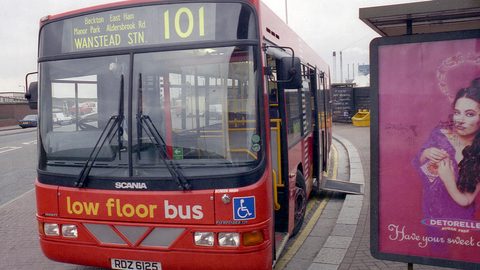
100% of TfL’s bus fleet is low-floor with a wheelchair ramp, as confirmed by the 2024 TfL buses accessibility page. Each bus has one designated wheelchair space. By TfL policy, wheelchair users have priority over buggies in that space. If a buggy is parked there, tell the driver. The driver will ask the buggy user to fold it. You board by asking the driver to deploy the manual ramp. There are no induction loops on buses, but all TfL buses have visual and audio next-stop announcements.
Getting To The Docklands Light Railway
The DLR is 100% accessible from street to platform, with 45 of 45 stations meeting that standard as of 2024. Trains are driverless, which means no staff on board to deploy a ramp. The platform gap is aligned to the 75 mm horizontal and 50 mm vertical thresholds for unassisted boarding. If you can board within those limits, you can travel alone. If you need a ramp, you must request assistance before boarding, because no driver exists to help. Book two hours ahead via the National Rail assisted travel phone number, or use the help point on the platform. For a citywide comparison of accessible transport, Berlin’s mix of modern trains and cobblestone streets presents a very different challenge from London’s step-free DLR.
The Last Mile Problem: from Step-Free Station to Soho Kerb
You exit a station with level access like Tottenham Court Road (Elizabeth line) and the pavement is flat. You roll 200 metres toward a restaurant in Soho and the kerb disappears. A dropped kerb is not guaranteed on any side street in Westminster. The failure case: you cannot find a dropped kerb within 50 metres of the restaurant. What you do: phone the restaurant before booking and ask which entrance has level access. If they cannot answer, skip that restaurant. The practical alternative is to take a black cab to the exact address, because the driver can deploy the ramp directly onto the pavement. That costs a minimum of £6.80 for the initial fare plus distance. Budget for that when planning a meal in Soho, Covent Garden, or any area with narrow pavements built before 2000.
For private hire, Addison Lee’s wheelchair-accessible vehicle fleet requires a minimum 30-minute advance notice. Book via the app or phone 020 7387 8888. For car hire with hand controls, Avis, Enterprise, and Hertz all offer adapted vehicles, but you must book a minimum of 48 to 72 hours ahead. Enterprise’s dedicated mobility line is 0345 604 0450. The type of hand controls is push-pull as standard; left-foot accelerator is available on request at some locations. Ask four questions when phoning: “What type of hand controls are fitted , push-pull or electronic?”, “Is the vehicle automatic or manual?”, “Can I inspect the controls before accepting the vehicle?”, and “Is there a 24-hour roadside assistance number if the adaptation fails?”


If You Are Hearing Impaired
All London Underground ticket office windows and most help points have induction loops. Black cabs have induction loops fitted as standard; switch your hearing aid to the ‘T’ position. Buses have no induction loops, but all TfL buses announce stops visually and audibly. The TfL Go app also shows real-time next-stop information.
| Mode | Step-Free Stations | Total Stations | Percentage |
|---|---|---|---|
| London Underground | 96 | 272 | 35% |
| Elizabeth line | 41 | 41 | 100% |
| Docklands Light Railway | 45 | 45 | 100% |
| London Overground | 62 | 113 | 55% |
| Tramlink | 39 | 39 | 100% |
Read next
-
 Accessible Hotels in London Chains Boroughs and the Questions to Ask
Which London hotels offer genuine wet rooms and turning space rather than just a grab bar, and the questions to ask before you book.
Accessible Hotels in London Chains Boroughs and the Questions to Ask
Which London hotels offer genuine wet rooms and turning space rather than just a grab bar, and the questions to ask before you book.
-
 Getting Around London for Disabled Travellers Buses Lifts and the Gaps
A practical look at accessible transport in London covering bus ramps, Tube lift gaps, and the reality of step-free stations for wheelchair users.
Getting Around London for Disabled Travellers Buses Lifts and the Gaps
A practical look at accessible transport in London covering bus ramps, Tube lift gaps, and the reality of step-free stations for wheelchair users.
-
 London Museums and Attractions with Free Carer Entry and Step-Free Access
Which London museums and attractions offer free carer entry, what proof you need, and the pre-booking steps that catch out spontaneous visitors.
London Museums and Attractions with Free Carer Entry and Step-Free Access
Which London museums and attractions offer free carer entry, what proof you need, and the pre-booking steps that catch out spontaneous visitors.
-
 Which Cities Are Genuinely Accessible Ranked by What Actually Matters
A candid ranking of accessible cities worldwide based on transport, terrain, hotels and the real experience of getting around in a wheelchair.
Which Cities Are Genuinely Accessible Ranked by What Actually Matters
A candid ranking of accessible cities worldwide based on transport, terrain, hotels and the real experience of getting around in a wheelchair.
-
 What Accessible Actually Means and Why Step-Free Is Not the Same Thing
Step-free is a measurement, accessible is a promise, and wheelchair friendly is often just optimism. Here is how to tell them apart.
What Accessible Actually Means and Why Step-Free Is Not the Same Thing
Step-free is a measurement, accessible is a promise, and wheelchair friendly is often just optimism. Here is how to tell them apart.
-
 Flying to London with a Wheelchair Your Rights and the Process
How flying with a wheelchair to London actually works, from Heathrow assistance to your legal rights if the airline damages your mobility equipment.
Flying to London with a Wheelchair Your Rights and the Process
How flying with a wheelchair to London actually works, from Heathrow assistance to your legal rights if the airline damages your mobility equipment.
-
 Booking an Accessible Hotel Room in London Questions That Get Real Answers
The exact questions to ask London hotels about accessible rooms, from roll-in shower dimensions to evacuation plans, so you book a room that actually works.
Booking an Accessible Hotel Room in London Questions That Get Real Answers
The exact questions to ask London hotels about accessible rooms, from roll-in shower dimensions to evacuation plans, so you book a room that actually works.
-
 London Travel Insurance with a Pre-Existing Condition What Gets Covered
What London travel insurance with a pre-existing condition actually covers, from emergency treatment at St Thomas' to wheelchair damage and trip cancellation.
London Travel Insurance with a Pre-Existing Condition What Gets Covered
What London travel insurance with a pre-existing condition actually covers, from emergency treatment at St Thomas' to wheelchair damage and trip cancellation.
-
 Mobile Data Planning for Wheelchair Users Traveling Abroad With eSIM
Plan mobile data for wheelchair travel abroad, with eSIM setup checks, lift outage updates, transport contacts, repair planning, and offline backups.
Mobile Data Planning for Wheelchair Users Traveling Abroad With eSIM
Plan mobile data for wheelchair travel abroad, with eSIM setup checks, lift outage updates, transport contacts, repair planning, and offline backups.